

Personal finance and tax..6 min read
Term insurance: ten times income is the brochure rule
The present value of a 35 year old's remaining earnings is about Rs 6.5 crore, not the Rs 2.5 crore a ten times income rule gives, and the extra cover costs about Rs 55 a day.
By Tanmay Kurtkoti, founder of QC Alpha and builder of RupeeCase
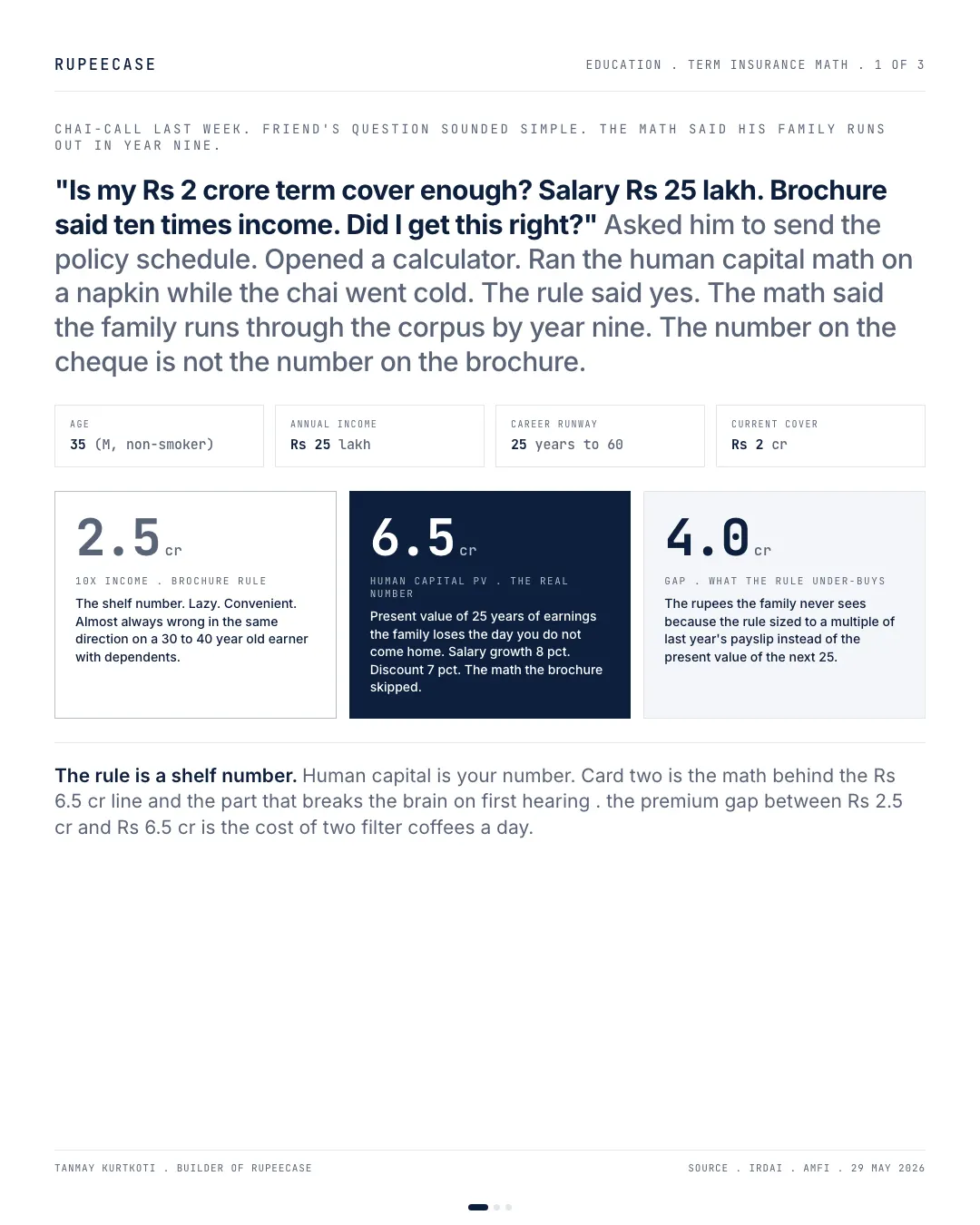
Friend on a chai-call last week asked if his Rs 2 crore term cover was enough. Salary Rs 25 lakh. The brochure rule that says "buy ten times income" said yes. Did the math on a napkin while the chai went cold. His family runs out of money in year nine.
The brochure rule is a shelf number. Convenient. Lazy. And almost always wrong in the same direction.
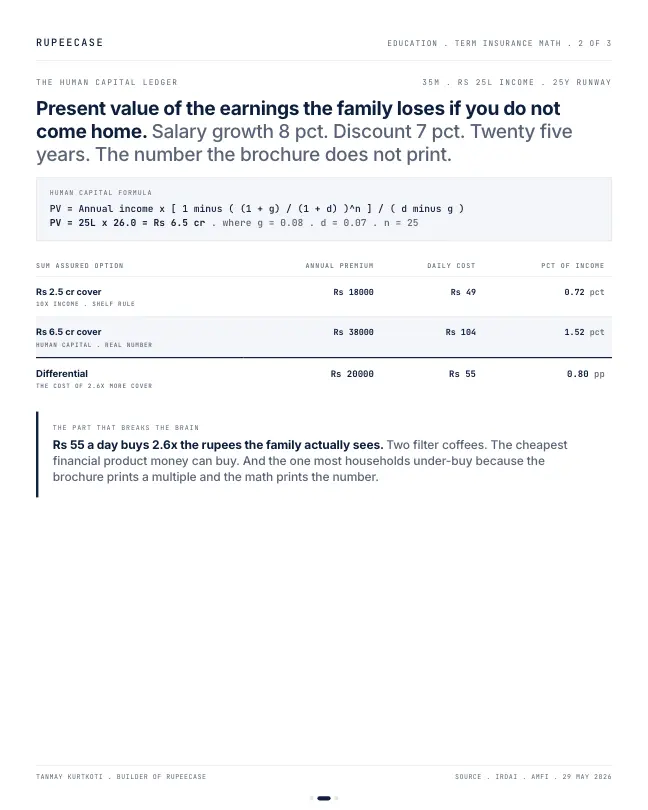
Here is the math the rule skips. He is 35. Career runway to 60 is 25 years. Salary grows 8 pct a year on a long-run base. Discount future rupees at 7 pct because today's rupee is worth more than tomorrow's. Present value of the earnings stream his family loses the day he does not come home is roughly Rs 6.5 crore. Not Rs 2.5 crore. The rule under-buys by Rs 4 crore.
The part that breaks people is the cost. Rs 2.5 crore cover at age 35 non-smoker on a 25-year term runs about Rs 18,000 a year. Rs 6.5 crore cover runs about Rs 38,000. Differential is Rs 20,000 a year. About Rs 55 a day. You are buying 2.6x the rupees the family actually sees for the cost of two filter coffees a day.
Term insurance is the cheapest financial product money can buy. It is also the one most households under-buy. Because the brochure prints a multiple and the math prints the number.
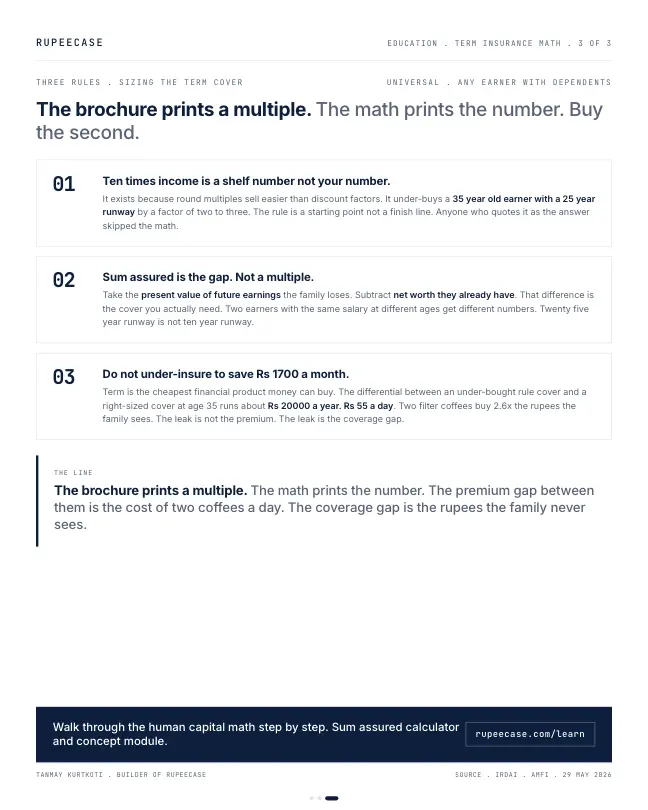
Three rules I tell anyone who asks. One. Ten times income is a shelf number not your number. Two. Sum assured is the gap . human capital minus net worth . not a multiple. Three. Do not under-insure to save Rs 1,700 a month.
Where the Rs 6.5 crore comes from
Human capital is a plain idea with an intimidating name. It is the value today of every salary you have not yet earned. Your family's lifestyle runs on that future stream, and a term policy is the one product that turns it into a lump sum if you are not there to earn it.
The arithmetic is a growing annuity. Year one salary is Rs 25 lakh. It grows 8 percent a year for 25 years, so the salary in year 25 is about Rs 1.59 crore. Each year's salary is then pulled back to today at 7 percent. Add the 25 discounted numbers and you get about Rs 6.55 crore. The formula is salary divided by (discount rate minus growth), times one minus ((1 + growth) divided by (1 + discount)) to the power of the years. When growth is higher than the discount rate, the top and bottom are both negative and the sum still works.
The reason it is so much bigger than ten times income: salary growth. A ten times rule quietly assumes your income never rises, and a 35 year old's income almost always does.
Ten times a Rs 25 lakh salary
Worked example
Present value of 25 years of salary
Worked example, 8% growth, 7% discount
The gap after the adjustments below
Worked example
From human capital to the gap
Rule two in the post says the cover is the gap, not the gross number. Here is how I turn one into the other, step by step, on the same example.
- Human capital: Rs 6.55 crorePresent value of 25 years of salary, growing 8 percent, discounted at 7 percent.
- Family's share: Rs 4.58 croreTake out income tax and his own spending. At an assumed 70 percent of gross reaching the household, 6.55 x 0.70.
- Add what is owed: plus Rs 60 lakhA home loan outstanding of Rs 60 lakh would otherwise fall on the family.
- Subtract what exists: minus Rs 40 lakhInvestments the family could draw on.
- The gap: about Rs 4.78 croreThis is the sum assured the math points to. Still almost twice the ten times rule.
The 70 percent is an assumption, not a rule. Your own number comes from your payslip and your budget. The method is what travels. If you already have large investments, the gap shrinks. If you have a large loan, it grows. A multiple of income can see neither.
Here is the same calculation with your inputs. Salary in lakh, rates in percent.
The need falls every year you work
One thing the brochure rule gets backwards: it grows with your salary, while the real need shrinks with every year you have already earned. Same Rs 25 lakh salary, same 8 and 7 percent, retirement at 60, only the age changes.
- Age 30, 30 years leftRs 8.05 Cr
- Age 35, 25 years leftRs 6.55 Cr
- Age 45, 15 years leftRs 3.74 Cr
- Age 55, 5 years leftRs 1.19 Cr
Present value of a Rs 25 lakh salary growing 8% a year, discounted at 7%, to age 60. Worked example.
This is the logic behind cover that runs to retirement age and not beyond: the need is largest early, in the years when the children are young and the loan is fresh. By 55 in this example it is down to Rs 1.19 crore, and the savings built up by then cover more of it each year.
Where the tax rules sit
Tax should not set the sum assured, but people ask. Under the old regime, life insurance premiums count towards the section 80C deduction, inside the shared Rs 1.5 lakh limit with 80CCC and 80CCD(1). Under the new regime, which is the default for AY 2026-27, 80C cannot be claimed at all (incometax.gov.in, e-filing help for AY 2026-27). On the payout side, section 10(10D) exempts any sum received on the death of the insured, and the premium to sum assured conditions that apply to maturity payouts do not apply to death benefits (Income-tax Act, 1961, section 10(10D), as published on the income tax department site). From tax year 2026-27 the Income-tax Act, 2025 renumbers these sections; the intent described here is what I would check against the new text.
So for most new regime filers, a term premium is pure protection with no tax angle. That is fine. Protection is the job.
The other half of protection
A term cover handles the worst case. An emergency fund handles the common ones: a job gap, a hospital bill before a claim settles, a repair. Premiums belong in the monthly essentials of that fund, because a lapsed policy protects nobody. The free emergency fund calculator adds premiums and EMIs to essentials for exactly this reason, and the free Learn module on risk management treats the household the way I treat a portfolio: name the risks that can end the plan, size each one, then decide. Hospital cover has its own fine print, and the room rent cap is the clause I see trip people most.
Questions readers ask
How much term insurance do I need for a Rs 25 lakh salary?
A ten times rule says Rs 2.5 crore. The present value of 25 more years of that salary, growing 8 percent and discounted at 7 percent, is about Rs 6.55 crore; after taking out tax and your own spending, adding loans and subtracting investments, the worked example in this post lands near Rs 4.78 crore. Your figure depends on your age, loans and savings.
What is human capital in insurance planning?
It is the value today of all the salary you expect to earn until you stop working. A 35 year old earning Rs 25 lakh with 25 working years left has roughly Rs 6.55 crore of it on the assumptions above, which is why the need for cover is highest early in a career and falls each year.
Can I claim term insurance premium under the new tax regime?
No. Under the new regime, the default for AY 2026-27, the 80C deduction is not available, so the premium gets no deduction. Under the old regime it counts within the Rs 1.5 lakh 80C limit, and a death payout is exempt under section 10(10D) in either case.
The cards
3 cards. Swipe, or tap to open.
Related
- The clause that shrinks your health coverA room at twice the policy's 1 percent daily cap settled the whole linked bill at half, turning a Rs 5 lakh cover into about Rs 2.5 lakh on the day it had to work.Personal finance and tax . . 5 min
- Gold: read the door before the metalRs 1 lakh of gold held eight years nets Rs 1,85,579 through an SGB bought at issue, Rs 1,56,985 through an ETF and Rs 1,34,804 as jewellery, so the vehicle decides.Personal finance and tax . . 5 min
- NPS, PPF, ELSS: the order matters more than the rateThe Rs 50,000 NPS slot under 80CCD(1B) sits on top of the 80C ceiling, so a rate led picker leaves Rs 15,600 a year of saved tax on the table at the 30 percent slab.Personal finance and tax . . 5 min
Educational content only. Figures are illustrative and computed on historical or representative data for teaching purposes, not investment advice. Past performance does not guarantee future returns. Sourced from NSE, BSE, SEBI, AMFI and RBI public data.