

Behaviour..5 min read
Risk tolerance is a mood
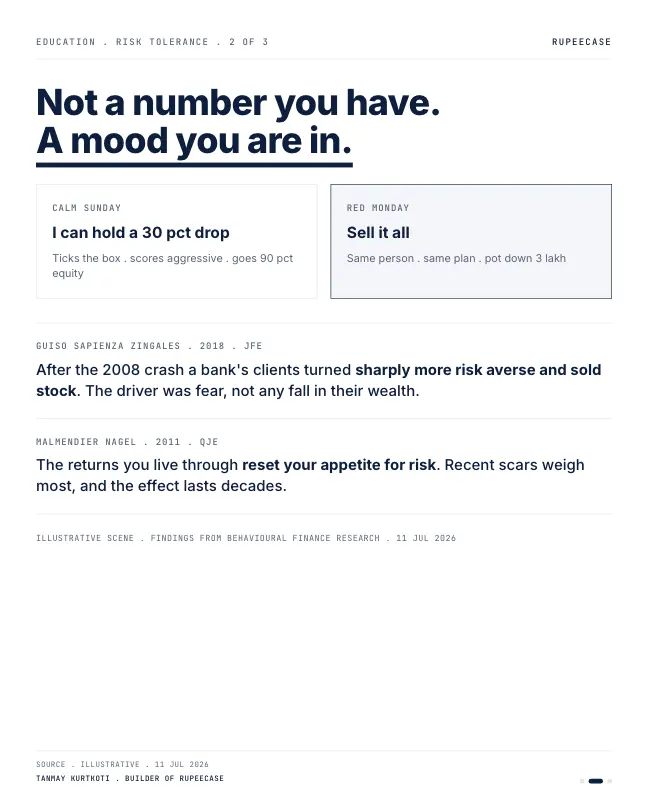
Guiso, Sapienza and Zingales found risk aversion rose sharply after 2008 on fear rather than wealth, so ask the drawdown question in rupees, not percentages.
By Tanmay Kurtkoti, founder of QC Alpha and builder of RupeeCase
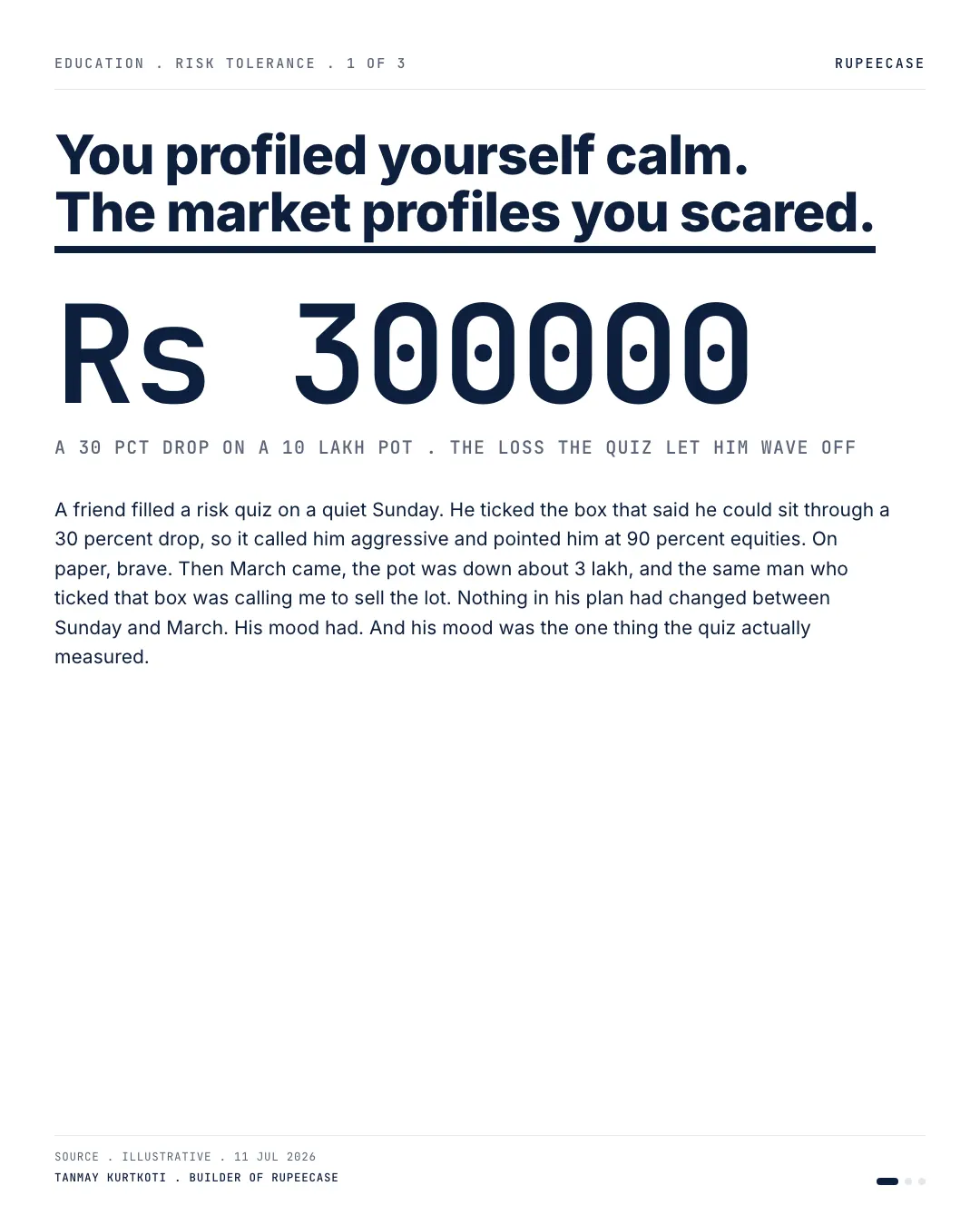
A friend filled out a risk questionnaire on a quiet Sunday afternoon. Twelve questions, a score, one word at the end. Aggressive. He ticked the box that said he could sit through a 30 percent drop, so it pointed him at 90 percent equities, and he went with it.
Then March arrived. His pot was down about 3 lakh. And the same man who had calmly ticked that box was on the phone asking me how fast he could sell the lot.
Nothing about his plan had changed between Sunday and March. His mood had. And his mood, it turns out, was the thing the quiz actually measured.
Here is what most risk profiling gets wrong. It treats your tolerance as a fixed trait, a number you carry around like your height. It is not. It is a reading, and the reading moves with the weather.
This is measured, not a feeling of mine. Guiso, Sapienza and Zingales followed a bank's clients straight through the 2008 crash and found their risk aversion rose sharply afterwards, and they sold stock. The trigger was not a fall in their wealth. It was fear. Malmendier and Nagel went wider and found the returns you personally live through reset your appetite for risk, recent scars weigh the most, and the effect lingers for decades.
So the profile you fill in feeling calm is answered by a different person than the one who shows up on a red morning.
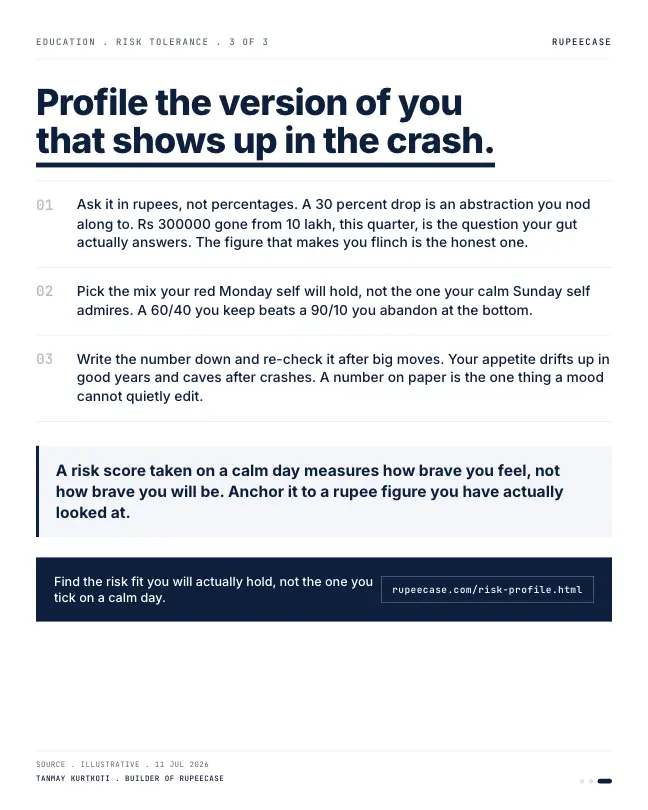
The fix is not a cleverer questionnaire. It is a better question. Ask it in rupees, not percentages. A 30 percent drop is an abstraction you nod along to. 3 lakh gone from 10, this quarter, is the real thing. If the rupee figure makes you flinch, that is your answer. Pick the mix your red-Monday self will actually hold, write the number down, and check it again after every big move.
What a real March looked like
March is not a figure of speech here. On NSE's closes the Nifty 50 was at 26,328.55 on 2 Jan 2026 and at 22,331.40 on 30 Mar 2026, a fall of 15.2 percent in under three months. March alone was minus 11.3 percent, the worst month in the two years of data I looked at. A portfolio 90 percent in an index like that lost about 13.7 percent in a quarter. On Rs 10 lakh, that is Rs 1.37 lakh, before any stock picking made it worse.
The questionnaire's 30 percent is not hypothetical either. Our own model strategies, all rules based and diversified, have drawdowns in that range in their back tests.
- Midcap Smallcap-26.17%
- Allcap-22.72%
- Large Cap Multi Asset-20.96%
- Large Mid Multi Asset-17.60%
- Dynamic Asset Allocator-10.57%
Maximum drawdown. Model, back tested, as of 27 Apr 2026. RupeeCase lineup.json.
Turn the percentage into rupees
The opening's fix is a conversion. Put your real numbers in and read the rupee line, then the line in months of expenses. The second is the one most people feel.
Rs 2,70,000 is what the friend's Rs 10 lakh at 90 percent equity looks like after a 30 percent fall: about the 3 lakh in the opening. At Rs 50,000 a month of spending, it is more than five months of household life. That is the number to sit with on a calm Sunday.
The decision you face on the red morning
What would you do?
It is 30 Mar 2026. The Nifty 50 has fallen 15.2 percent since 2 Jan and 11.3 percent this month alone.
- Sell the lot and wait for calm
The index closed Apr 2026 at 23,997.55, 7.5 percent above the 30 Mar close. Selling at the low locked in the fall just before the bounce.
- Do what the written plan says
If the mix was sized in rupees beforehand, the plan already priced a month like this. By 31 Jul 2026 the index was 9.2 percent above the March low, though still below its Jan high.
- Cut equity to half and decide later
A midway sale feels safer but is still a decision made on the worst day. The index rose in the following month while the cash waited for a signal to come back in.
NSE, Nifty 50 closes: 26,328.55 on 2 Jan 2026, 22,331.40 on 30 Mar 2026, 23,997.55 on 30 Apr 2026, 24,383.60 on 31 Jul 2026. Not a promise of what any fall does next.
The honest note on that scenario: by early Oct 2026 the index was back near its March level. Holding was not rewarded quickly or neatly. The point is that the right mix is the one you can keep through a sequence like that without making a fresh decision every week.
Make the profile a check, not a label
SEBI's rules for registered investment advisers already require a client's risk profile before any advice. The useful version for yourself is short and repeated.
- Write the rupee numberThe largest fall in rupees you would hold through, on a calm day.
- Match the mix to itEquity share times a fall like 25 to 30 percent should not exceed that number.
- Check after big movesAfter any fall of 10 percent or more, read the number again before acting.
- Change the plan on a calm dayIf the number was wrong, adjust the mix after the market settles, not at the low.
Our risk profile asks the question in rupees for this reason. The free Learn module on risk management for systematic portfolios covers drawdown budgets and allocation sizing, and the asset allocation calculator turns a horizon and a drawdown limit into a mix. The post on action bias looks at what selling at the low costs in units.
Questions readers ask
Does risk tolerance change over time?
Yes. Studies quoted in the opening found that risk aversion rose sharply after the 2008 crash because of fear rather than a fall in wealth, and that the returns people live through shape their appetite for years. A questionnaire answered on a calm day often overstates what you will hold through a fall.
How do I measure my real risk tolerance?
Convert the percentage into rupees and months of spending. A 30 percent fall on Rs 10 lakh at 90 percent equity is Rs 2,70,000, more than five months of expenses at Rs 50,000 a month. If that figure would make you sell, the mix is too aggressive for you.
How much did the Nifty 50 fall in March 2026?
On NSE's closes the Nifty 50 fell 11.3 percent in March 2026 and closed at 22,331.40 on 30 Mar, 15.2 percent below its 2 Jan 2026 close of 26,328.55.
The cards
3 cards. Swipe, or tap to open.
Related
- Doing nothing is the skillKeepers who stay in the centre save about a third of penalties and dive anyway; the investor who sold a 30 percent fall and bought back higher ended with 3,000 fewer units.Behaviour . . 5 min
- The disposition effectOdean found investors 1.5 times more likely to sell a winner than a loser, and the winners they sold beat the losers they kept by 3.4 points over the next year.Behaviour . . 10 min
- Confirmation bias: research or hopeLord, Ross and Lepper's 1979 study showed mixed evidence hardens both sides, and cutting at minus 15 instead of holding through minus 40 ends Rs 3.51 lakh ahead on Rs 10 lakh.Behaviour . . 9 min
Educational content only. Figures are illustrative and computed on historical or representative data for teaching purposes, not investment advice. Past performance does not guarantee future returns. Sourced from NSE, BSE, SEBI, AMFI and RBI public data.