

Returns and risk maths..5 min read
Real vs nominal: the three numbers in a return
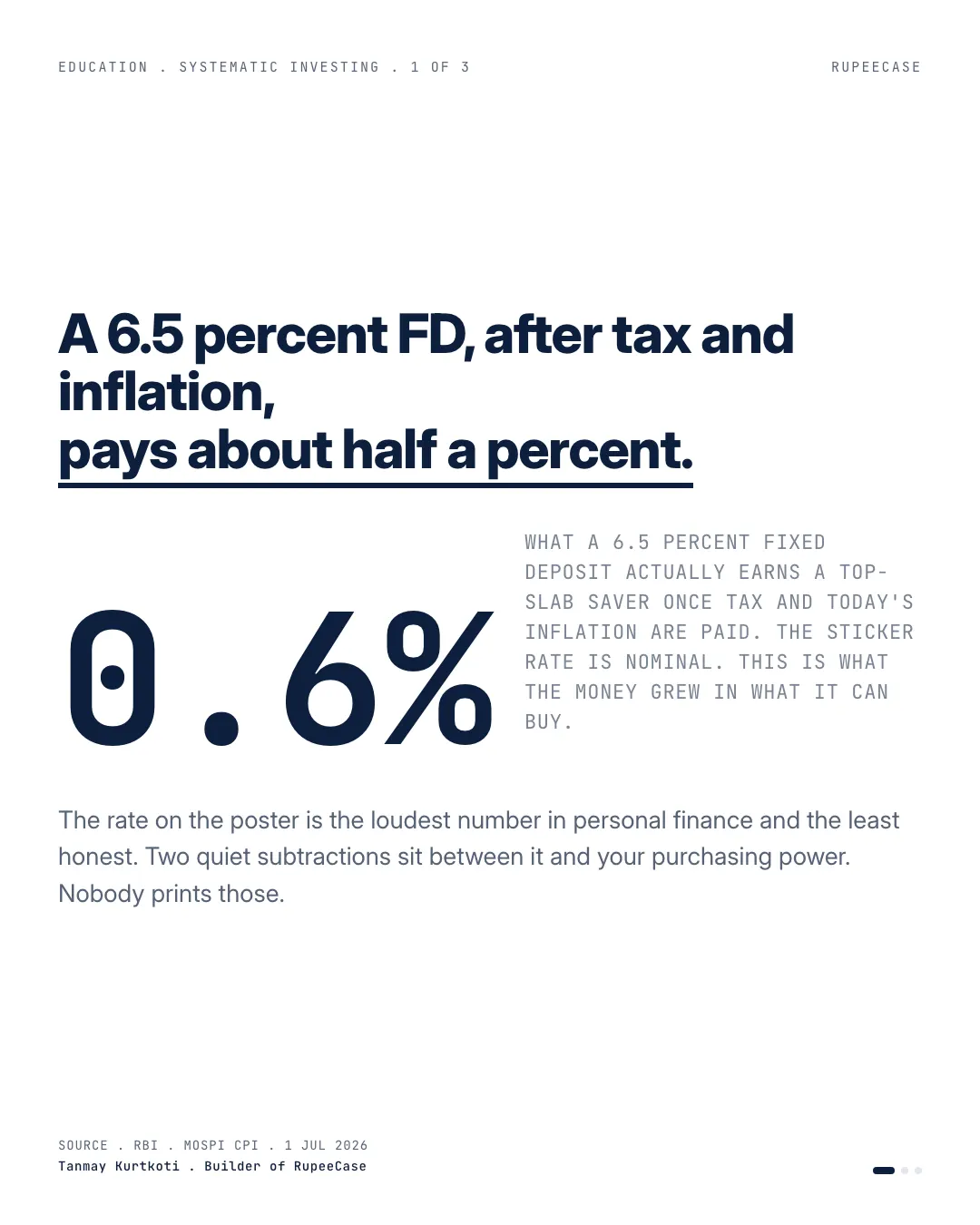
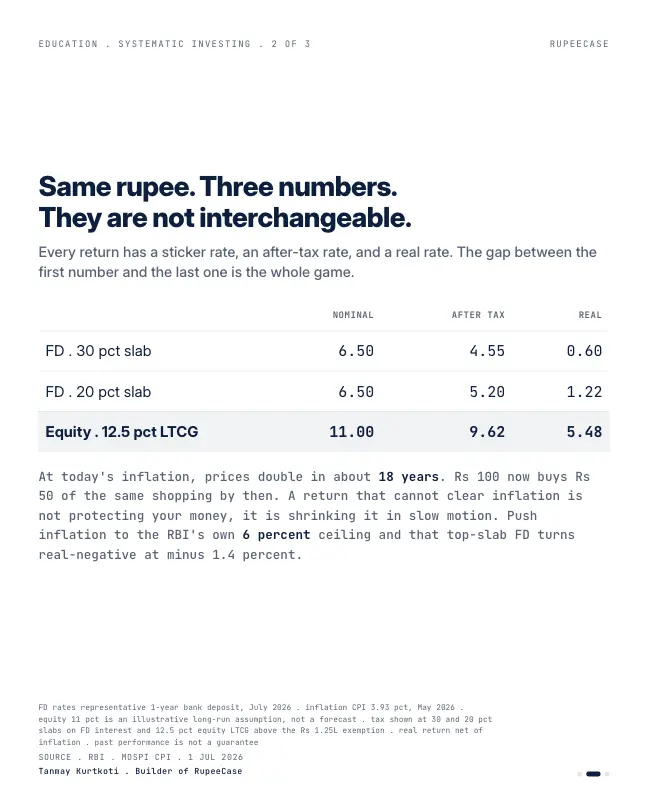
A 6.5 percent fixed deposit becomes 4.55 after top slab tax and about 0.6 percent after 4 percent inflation, and turns real negative at the RBI's 6 percent ceiling.
By Tanmay Kurtkoti, founder of QC Alpha and builder of RupeeCase
A friend called his new fixed deposit the safe part of his portfolio. 6.5 percent, locked for a year, done. He was pleased with himself.
I asked him one question. What does it earn after tax and after inflation.
Here is the part the poster never shows you. A return has three numbers, and only the last one is real.
The 6.5 percent is the sticker. Nominal, pre-tax, the loudest number in personal finance. His slab takes 30 percent of the interest every year, and it is taxed whether he touches it or not. That leaves 4.55. Then inflation, running near 4 percent right now, takes its cut of what those rupees can actually buy. What is left, the real return, is about 0.6 percent.
The 6.5 was never the return. It was the headline.
And that is at today's benign inflation. Push it to the 6 percent ceiling the RBI itself tolerates and the same top-slab FD turns real-negative, around minus 1.4 percent. It keeps every rupee and quietly buys less each year. At 4 percent inflation, prices double in roughly 18 years. Rs 100 now is Rs 50 of the same shopping by then.
None of this makes a fixed deposit bad. It makes nominal a lie you tell yourself. Capital protection measured in rupees can be capital erosion measured in purchasing power.
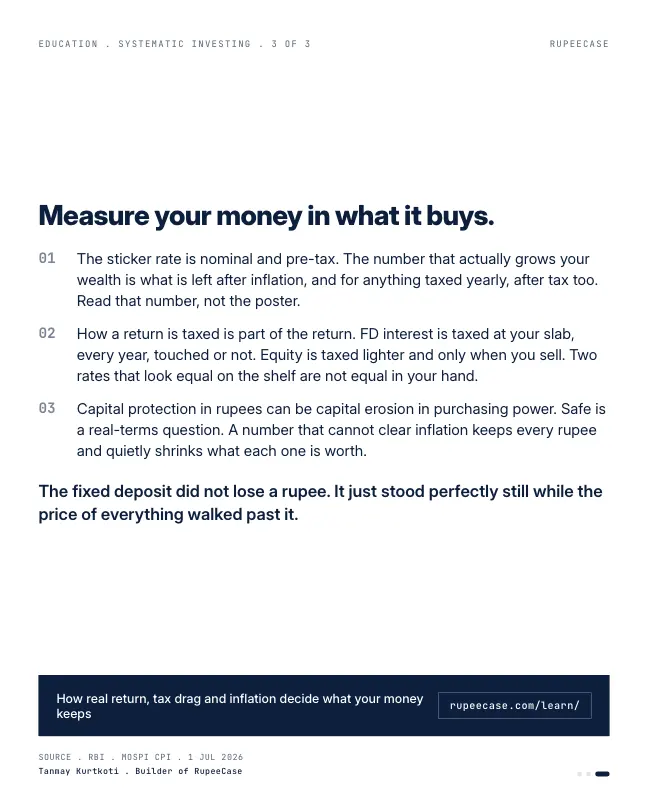
Two things worth carrying. How a return is taxed is part of the return: FD interest is taxed at your slab every year, equity is taxed lighter and only when you sell, so two rates that look equal on the shelf are not equal in your hand. And safe is a real-terms question: a number that cannot clear inflation is not protecting your money, it is watching it shrink in slow motion.
The fixed deposit did not lose a rupee. It just stood still while the price of everything walked past it.
The three numbers, in order
- NominalThe sticker. 6.5 percent on the deposit receipt.
- After tax6.5 x (1 minus 0.30) = 4.55 percent in the top slab.
- Real1.0455 / (1 + inflation) minus 1. What the money can buy.
Only the third number answers the question my friend actually cared about: will this money buy more next year than it does today. The first two are steps on the way.
Since July, the third number turned
When I wrote the opening at the start of July, inflation was running near 4 percent. MOSPI's data since then shows how quickly that changed. CPI inflation on the new 2024 base went from 2.74 percent in Jan 2026 to 4.45 percent in Jul 2026 and 4.82 percent in Aug 2026, by the release of 14 Sep 2026.
Put the top slab deposit's 4.55 percent after tax next to that line.
CPI inflation rose from 2.74 percent in Jan 2026 to 4.82 percent in Aug 2026. The after tax rate on a 6.5 percent deposit in the 30 percent slab is 4.55 percent, so it fell below inflation in Aug 2026.
MOSPI, CPI (base 2024=100) all India combined inflation, Jan to Aug 2026 (Aug provisional), press release of 14 Sep 2026. Deposit line is the worked example.
In January the same deposit was about 1.8 points ahead of prices in real terms. By August it was about a quarter of a point behind. The deposit did not change. The third number did.
Here is the real return at a few inflation levels, so you can see how sensitive it is.
- Inflation 2%2.50%
- Inflation 4%0.53%
- Inflation 4.82%, Aug 2026-0.26%
- Inflation 6%, RBI ceiling-1.37%
Real return = 1.0455 / (1 + inflation) minus 1. Inflation 4.82 percent from MOSPI, Aug 2026. RBI target band 2 to 6 percent.
These are the exact figures, using division. The opening used subtraction, which gives 0.55 and minus 1.45 at 4 and 6 percent. Close enough for a conversation, but the gap grows as inflation rises.
The doubling of prices
There is a quicker way to feel inflation. Divide 72 by the rate. At 4.82 percent, 72 / 4.82 is about 15. Prices double in roughly fifteen years at that pace, a little sooner than the eighteen years the opening worked out at 4 percent. Rs 100 of shopping today needs about Rs 200 then.
Tax timing is part of the return
The opening ended on a point that deserves numbers. Deposit interest is taxed at your slab every year. Listed equity gains held over twelve months are taxed at 12.5 percent above Rs 1.25 lakh of gains in a year, and only when you sell, under the rules in force since 23 Jul 2024.
So take the same 6.5 percent a year for ten years on Rs 10 lakh, taxed two ways. This is only about tax. Equity returns are not fixed and carry real risk, so this compares the tax treatment, not the two products.
About Rs 2.2 lakh of difference from the timing and rate of tax alone. That is why two rates that look the same on a shelf are not the same in your hand.
The free Learn module on inflation explains how CPI is built, why the 2024 base matters and how inflation moves through to every asset class, with quizzes and a certificate. The deposit side, slab by slab, is in after tax and inflation, safe can go backwards.
Questions readers ask
What is the difference between real and nominal return?
Nominal return is the stated rate, before tax and inflation. Real return is what is left after inflation, and ideally after tax too: it tells you how much more the money can buy. A 6.5 percent deposit in the 30 percent slab had a real return of about minus 0.26 percent at Aug 2026 inflation of 4.82 percent.
How do I calculate real return?
Divide one plus the after tax return by one plus inflation and subtract one. For 4.55 percent after tax and 4.82 percent inflation: 1.0455 / 1.0482 minus 1 = minus 0.26 percent. Subtracting inflation from the return is a quick approximation.
What inflation rate does the RBI target?
The RBI targets CPI inflation of 4 percent, with a tolerance band from 2 to 6 percent. CPI inflation was 4.82 percent in Aug 2026, inside the band but above the target.
The cards
3 cards. Swipe, or tap to open.
Explore next
Learn it properly, then see it applied.
Reading path
Stop 7 of 8 on What a return number hides
Related
- After tax and inflation, safe can go backwardsA 7 percent fixed deposit nets about 4.9 after top slab tax and roughly zero after 5 percent inflation, so Rs 10 lakh that doubled on paper buys less than it did.Returns and risk maths . . 5 min
- The bigger number is the smaller returnA fund up 214 percent over twelve years earned about 10 percent a year, roughly half the 19 percent a year of the fund with the smaller looking figure.Returns and risk maths . . 6 min
- Drawdown: depth vs durationTwo funds with the same 20 percent max drawdown spent seven and twenty six months below their old highs, and the wait is where plans die by quiet quitting.Returns and risk maths . . 7 min
Educational content only. Figures are illustrative and computed on historical or representative data for teaching purposes, not investment advice. Past performance does not guarantee future returns. Sourced from NSE, BSE, SEBI, AMFI and RBI public data.