

Returns and risk maths..5 min read
After tax and inflation, safe can go backwards
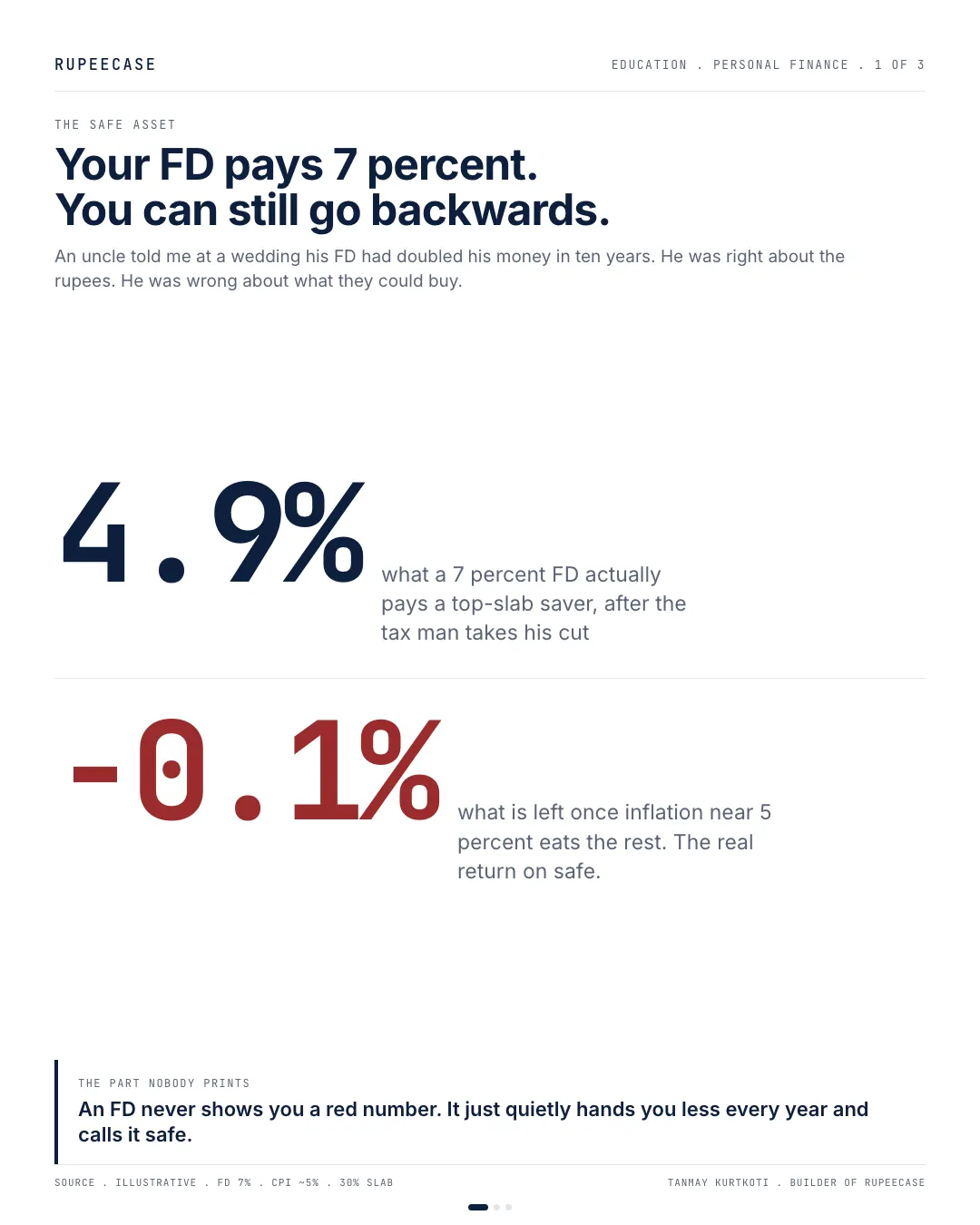
A 7 percent fixed deposit nets about 4.9 after top slab tax and roughly zero after 5 percent inflation, so Rs 10 lakh that doubled on paper buys less than it did.
By Tanmay Kurtkoti, founder of QC Alpha and builder of RupeeCase
An uncle cornered me at a wedding last month to tell me his fixed deposit had doubled his money in ten years. Proud of it. And he was right, sort of. The rupees did roughly double. What I did not have the heart to say over the buffet is that the part that matters, what those rupees can actually buy, barely moved.
Here is the part the statement never shows you.
A 7 percent FD does not pay a 7 percent return. If you are in the top tax slab, 30 percent of that interest goes to tax every year, so you are really earning 4.9. Then inflation running near 5 percent quietly takes the rest. What is left, the real return, is roughly zero. For a top-slab saver it actually tips slightly negative.
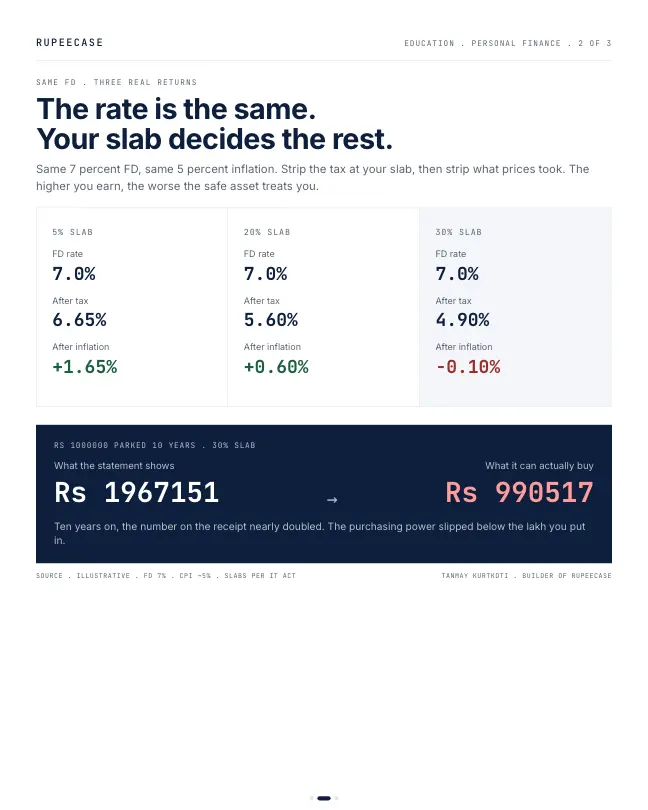
The cruel part is what it looks like. The same 7 percent FD pays three different people three different real returns. A 5 percent slab saver keeps about +1.65 percent in real terms. A 20 percent slab saver keeps +0.60. A 30 percent slab saver lands at minus 0.10. Same poster rate. Your tax slab decides whether safe is even keeping up with prices.
Put numbers on it. Ten lakh parked for ten years at the top slab grows to about 19.67 lakh on the statement. Feels like it doubled. Strip the tax and the inflation and the purchasing power is around 9.9 lakh. Less than the lakh you started with, in real terms.
This is not an argument against fixed deposits. It is an argument against using one for the wrong job. An FD is a parking spot. Perfect for your emergency fund and money you need in a year or two, where not falling is the whole point. It is a poor engine for a twenty-year goal, where erosion compounds against you the same way growth would have compounded for you.
The honest version: an FD never shows you a loss. That is exactly why it is the easiest place to lose money slowly.
Today's numbers, not round ones
The wedding conversation used round figures. Here are the current ones, so the arithmetic is anchored to something you can look up.
CPI inflation, Aug 2026, year on year
MOSPI, CPI press release, 14 Sep 2026
RBI repo rate after the October policy
RBI, Monetary Policy Statement, 7 Oct 2026
top slab, new regime, income above Rs 24 lakh
Finance Act 2025 slabs, FY 2025-26 onwards
Inflation on the new CPI series was 4.82 percent in Aug 2026, by the MOSPI release of 14 Sep 2026. The RBI's own target is 4 percent, with a band of 2 to 6 percent. Fixed deposit rates tend to move with the repo rate, which the RBI raised to 5.50 percent on 7 Oct 2026.
The 7 percent FD, slab by slab
Take a 7 percent deposit and 4.82 percent inflation. Step one: take the tax off the interest. Step two: take inflation off what is left. The honest way to do step two is to divide, not subtract:
Real return = (1 + after tax return) / (1 + inflation) minus 1.
For the top slab: 7 x (1 minus 0.30) = 4.90 percent after tax. Then 1.049 / 1.0482 minus 1 = 0.08 percent. For someone in the 10 percent slab: 7 x 0.90 = 6.30, then 1.063 / 1.0482 minus 1 = 1.41 percent.
- No tax2.08%
- 5% slab1.75%
- 10% slab1.41%
- 15% slab1.08%
- 20% slab0.74%
- 30% slab0.08%
Real return a year on a 7 percent deposit at 4.82 percent inflation (MOSPI, Aug 2026). Before cess and surcharge. Worked example.
At 4.82 percent inflation the top slab saver is roughly at zero. At the 5 percent inflation in the opening, the same saver tips just below zero. The difference between those two is small. The direction is the point: for the highest slab, a 7 percent deposit is close to standing still in what the money can buy.
Your own deposit, live
Ten lakh for ten years at the top slab becomes about Rs 16.13 lakh after tax. In today's rupees that is about Rs 10.08 lakh. Ten years of waiting bought almost nothing extra. The statement in the opening showed Rs 19.67 lakh because it is the pre tax figure, which is the number most people look at.
Parking spot or engine
None of this makes a deposit a bad product. It makes it a product with a job.
Money you need soon
- Emergency fund, 6 to 12 months of expenses
- A known bill in one or two years
- Not falling matters more than growing
Money for a goal 15 to 20 years away
- Near zero real return compounds to near zero
- Tax every year, even if you never withdraw
- Inflation erosion compounds the same way growth would
I keep this split in mind whenever I look at a family balance sheet. The question is never whether a deposit is safe. It is whether it is safe for that particular job.
The free Learn module on bonds and fixed income in India covers deposits, government bonds, duration and how rate moves change their value, with quizzes and a certificate. The three number version of this idea is in real against nominal return, and the long horizon side in time diversification.
Questions readers ask
What is the real return on a fixed deposit in India?
Take the deposit rate, remove tax at your slab, then adjust for inflation. On a 7 percent deposit with CPI inflation at 4.82 percent (Aug 2026), the real return is about 2.1 percent with no tax and close to zero in the 30 percent slab.
Is FD interest taxed every year even if I do not withdraw it?
Usually, yes. Interest on a cumulative deposit is normally declared each year as it accrues, at your slab rate, rather than only at maturity. That yearly tax is one reason the after tax compounding rate is lower than the headline rate.
Should real return be calculated by subtracting inflation?
Subtracting is a quick estimate. The exact form divides: (1 + after tax return) divided by (1 + inflation), minus 1. At low rates the two are close; as inflation rises, the subtraction drifts further from the exact figure.
The cards
3 cards. Swipe, or tap to open.

Explore next
Learn it properly, then see it applied.
Related
- Real vs nominal: the three numbers in a returnA 6.5 percent fixed deposit becomes 4.55 after top slab tax and about 0.6 percent after 4 percent inflation, and turns real negative at the RBI's 6 percent ceiling.Returns and risk maths . . 5 min
- The long run makes the rate safe and the rupees wildTwenty years narrows the annualised range to about 6 to 15 percent while the rupee outcome on Rs 10 lakh fans out from Rs 31 lakh to Rs 1.56 crore.Returns and risk maths . . 5 min
- Average return vs CAGRUp 50 then down 50 averages zero and loses a quarter of the money, and two funds averaging 12 percent at 8 and 30 percent volatility end twenty years at Rs 91 lakh and Rs 42 lakh.Returns and risk maths . . 5 min
Educational content only. Figures are illustrative and computed on historical or representative data for teaching purposes, not investment advice. Past performance does not guarantee future returns. Sourced from NSE, BSE, SEBI, AMFI and RBI public data.