

Personal finance and tax..5 min read
Lifestyle creep: the raise that never reaches the portfolio
Banking half of every increment lifts a savings rate from 20 to 35 percent without a felt cut and ends Rs 21.5 lakh ahead over a decade on the same income and returns.
By Tanmay Kurtkoti, founder of QC Alpha and builder of RupeeCase
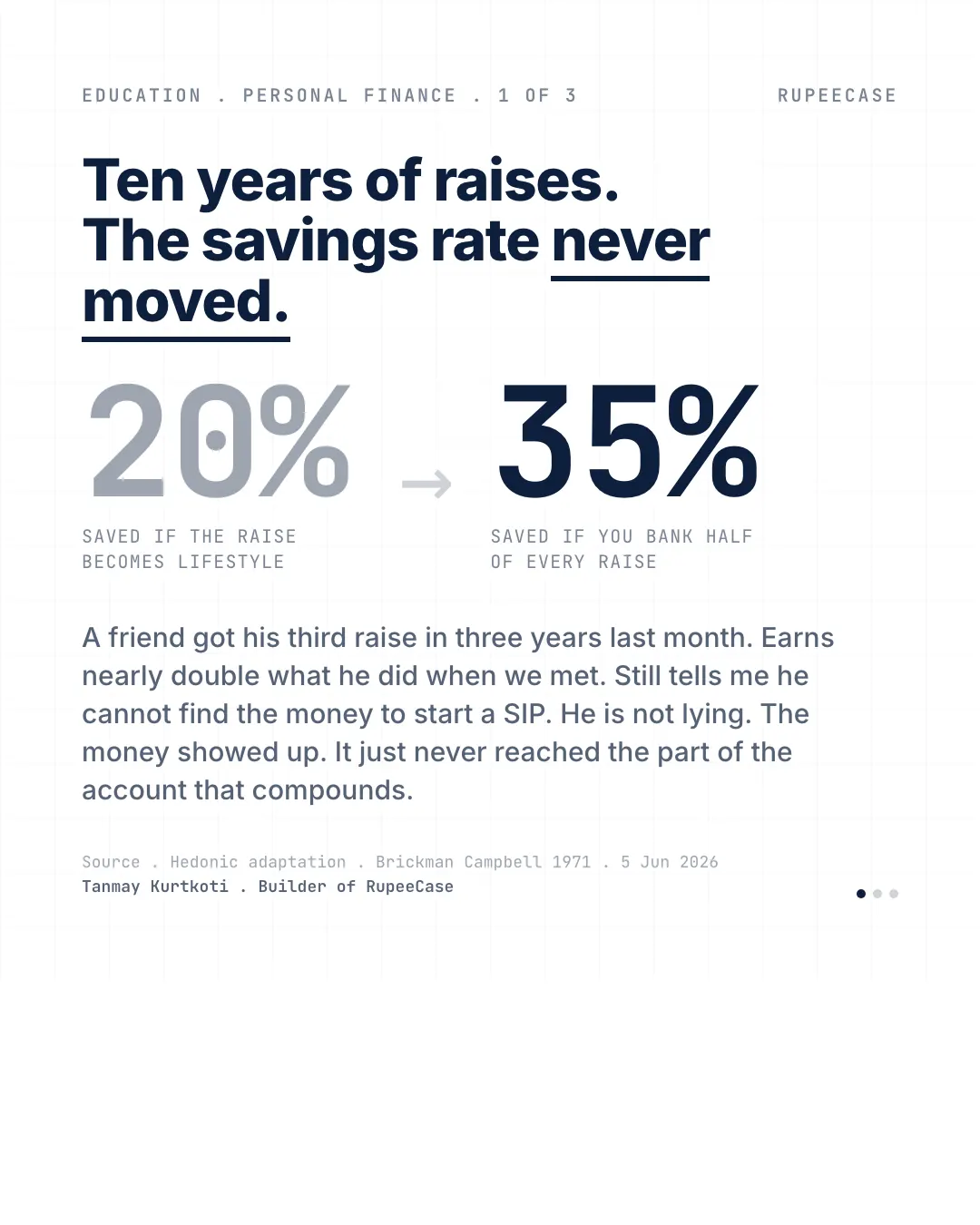
A friend got his third raise in three years last month. He earns nearly double what he did when we met. And he still tells me, with a straight face, that he cannot find the money to start a SIP.
The strange thing is he is not lying. The money genuinely showed up. It just never reached the part of the account that compounds.
This is lifestyle creep, and it is the quietest leak in personal finance. Not a bad fund. Not a high fee. Just spending that expands to fill whatever lands in the account. The raise arrives, the standard of living rises to meet it, and somehow there is nothing extra to invest.
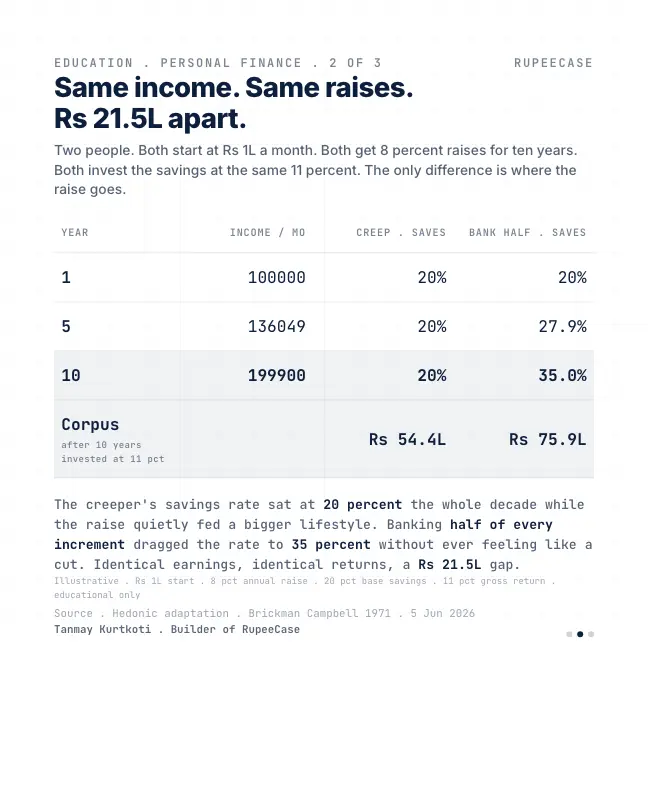
I ran the numbers on two people to see how much it actually costs. Both start at Rs 1L a month. Both get 8 percent raises for ten years. Both invest their savings at the same 11 percent. The only thing that differs is where the raise goes.
The first one keeps a flat 20 percent savings rate the whole decade. The raise feeds a bigger lifestyle. He ends with about Rs 54.4L.
The second one banks half of every increment before it touches his baseline. His savings rate drifts from 20 to 35 percent without a single moment that feels like a cut. He ends with about Rs 75.9L.
Same income. Same raises. Same returns. A Rs 21.5L gap, paid entirely by the version of him that let the raise become lifestyle.
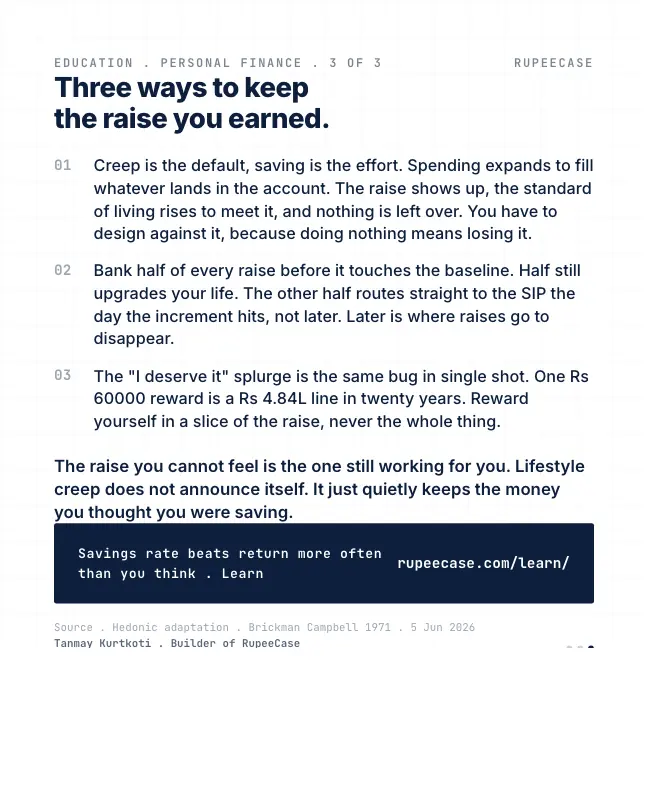
The single-purchase cousin of this is the "I deserve it" splurge. One Rs 60,000 reward is a Rs 4.84L line twenty years out. The reward is real. The price tag just shows up much later, and much bigger.
Honest version: you will never out-earn this by picking a better fund. You beat it by deciding, before the raise lands, that half of it routes straight to the SIP. Half still upgrades your life. The other half keeps working.
The raise you cannot feel is the one still doing your job for you:
How the savings rate climbs without a cut
I reran the two people to check the opening. The figures reproduce when each year's savings are added at the end of the year and the pot grows at 11 percent: Rs 54.4 lakh for the flat saver and Rs 75.9 lakh for the one who banks half of each raise.
The second person's savings rate is the interesting line. He never cuts spending. His spending still rises every year, by half of each raise. But because the saved half compounds on top of a growing salary, the share of income he saves climbs steadily.
- Year 120.0%
- Year 324.3%
- Year 527.9%
- Year 832.5%
- Year 1035.0%
Worked example: Rs 1 lakh a month, 8% raise a year, half of each raise saved, spending starts at Rs 80,000.
By year ten his salary is about Rs 2 lakh a month and he spends about Rs 1.3 lakh, against Rs 80,000 when he started. That is a 62 percent rise in lifestyle. The flat saver's lifestyle rose 100 percent. The difference between those two upgrades is the whole Rs 21.5 lakh.
Your own raise, split in advance
Try 25 percent saved. The savings rate still rises, to about 22.5 percent, and spending rises by three quarters of every raise. The rule does not need to be heroic. It needs to be decided before the money arrives.
Part of every raise is inflation anyway
There is a quieter reason to bank part of a raise. Some of it was never extra money. All India CPI inflation was 4.82 percent in Aug 2026, on MOSPI's figures. An 8 percent raise in a 4.82 percent year is a real raise of about 3 percent. If the whole raise goes to lifestyle, lifestyle grew by 8 percent while purchasing power grew by about 3. The rest was spending you had to do just to stand still, plus spending you chose.
raise in the worked example
Worked example
all India CPI inflation, Aug 2026
MOSPI, 14 Sep 2026
the real raise: 1.08 divided by 1.0482, minus 1
Worked example
Make the split automatic
Willpower loses to a bigger salary credit every time. The fix is mechanical, set up once.
- Before appraisalDecide the share of any raise that goes to savings.
- First new payslipRaise the SIP by that share of the take home increase.
- Lock it inSet a yearly step up on the SIP so next year needs no decision.
- Spend the restThe other half upgrades your life without guilt.
The step up feature on a SIP does the third step for you. The step up SIP calculator shows what a 5 or 10 percent yearly increase does over 20 years, and the post on the step up SIP runs it against chasing two extra points of return. The free Learn module on building systems that protect you from yourself covers pre commitment and automation as investing tools.
Questions readers ask
What is lifestyle creep?
It is spending that rises with every increase in income, so savings stay flat in rupees or as a share of pay even as you earn more. Over ten years of 8 percent raises, it cost the worked example Rs 21.5 lakh against saving half of each raise.
How much of a salary hike should I save?
There is no single right share, but deciding it before the raise arrives is what makes it stick. Saving half of each 8 percent raise lifts a 20 percent savings rate to 35 percent in ten years while spending still grows by about 62 percent.
Does an 8 percent raise beat inflation?
With all India CPI inflation at 4.82 percent in Aug 2026 (MOSPI), an 8 percent raise is about a 3 percent rise in purchasing power. The rest only keeps your spending where it was in real terms.
The cards
3 cards. Swipe, or tap to open.
Explore next
Learn it properly, then see it applied.
Related
- The lever you control beats the one you chaseTwo extra points of return over 25 years adds Rs 82 lakh to a Rs 10,000 SIP; stepping the same SIP up 10 percent a year adds Rs 2.35 crore.Personal finance and tax . . 4 min
- The flat SIP shrinksRs 10,000 a month buys about Rs 7,473 of 2021 purchasing power after five years at 6 percent inflation, and a 10 percent annual step up doubles the twenty year corpus.Personal finance and tax . . 8 min
- Goal based investing: the goal picks the vehicleA college seat three years out and a retirement twenty two years out are a debt problem and an equity problem, and a Rs 20 lakh seat is Rs 63.4 lakh at 8 percent inflation.Personal finance and tax . . 6 min
Educational content only. Figures are illustrative and computed on historical or representative data for teaching purposes, not investment advice. Past performance does not guarantee future returns. Sourced from NSE, BSE, SEBI, AMFI and RBI public data.