

Personal finance and tax..5 min read
Gold: read the door before the metal
Rs 1 lakh of gold held eight years nets Rs 1,85,579 through an SGB bought at issue, Rs 1,56,985 through an ETF and Rs 1,34,804 as jewellery, so the vehicle decides.
Dated note: the gold price and import duty figures are as of 26 May 2026. There has been no new sovereign gold bond tranche since February 2024 (secondary sources), and from 1 Apr 2026 the tax exemption on maturity applies only to original subscribers.
By Tanmay Kurtkoti, founder of QC Alpha and builder of RupeeCase
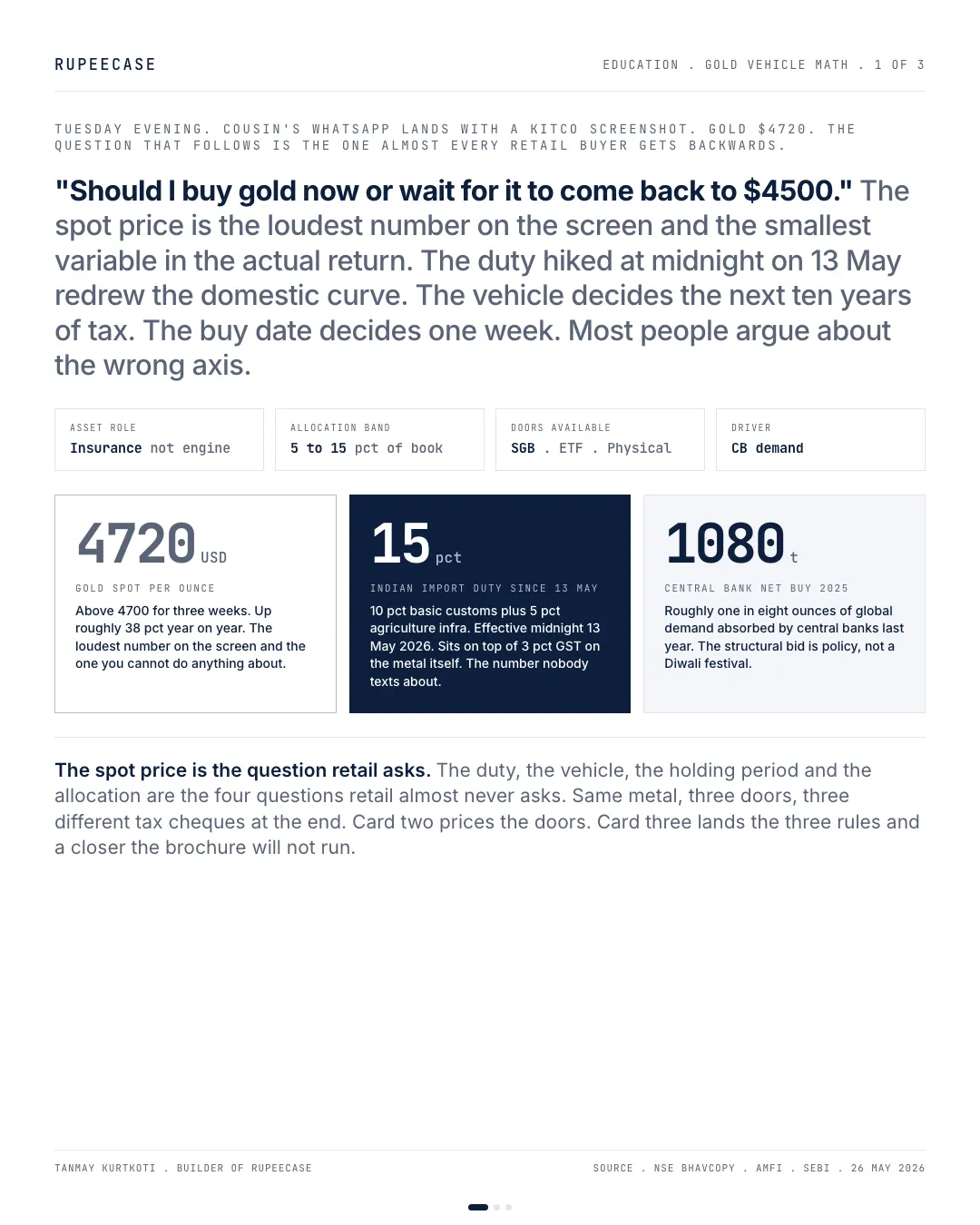
Cousin's message lands Tuesday evening. A gold price screenshot. Gold at $4720.
"Should I buy now or wait for $4500."
Wrong question.
The spot price is the loudest number on the screen and almost the smallest variable in the actual return. The duty hiked at midnight on 13 May redrew the domestic curve. The vehicle decides the next ten years of tax. The buy date decides one week of regret. Most people argue about the wrong axis.
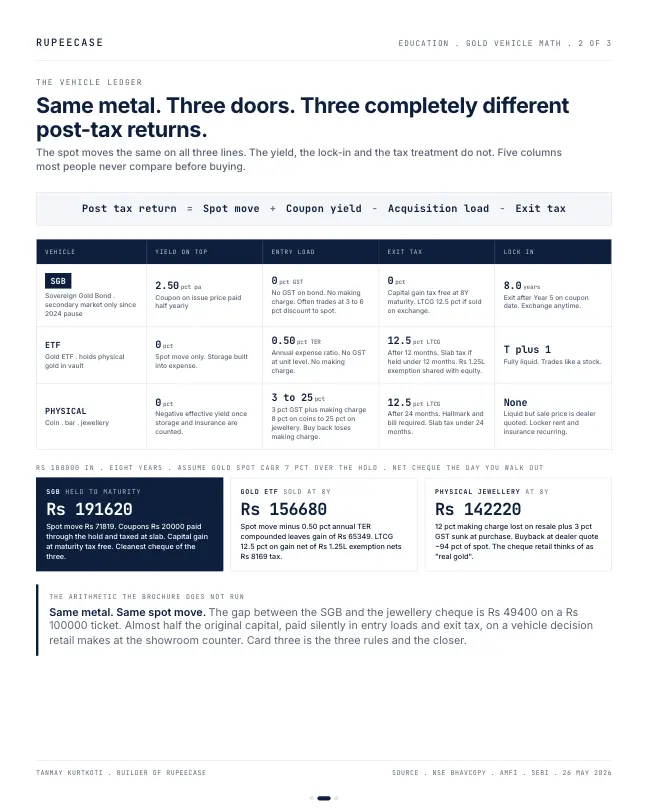
Pulled the math the way I would pull it for a real portfolio decision. Rs 1,00,000 going in, eight years forward, assume gold spot compounds at 7 pct over the hold. Three doors. Three different cheques.
SGB bought at issue and held to maturity nets Rs 1,85,579. Spot move plus 2.5 pct coupon every year, taxed at your slab, plus a capital gain that is tax free at year eight. From 1 Apr 2026 that exemption holds only for bonds subscribed at original issue, so a bond bought on the exchange today nets Rs 1,76,242, and no fresh tranche has been issued since Feb 2024.
Gold ETF sold at the same point nets Rs 1,56,985. Spot move minus 0.50 pct annual TER minus 12.5 pct LTCG plus cess on the whole gain. The Rs 1.25 lakh exemption covers listed equity and equity funds only, never gold.
Physical jewellery bought back at the same point nets Rs 1,34,804 after tax. Three pct GST sunk at purchase plus 12 pct making charge lost on resale plus dealer quote at ~94 pct of spot.
Rs 50,775 gap on the same metal. Almost half the original capital, paid silently in entry loads and exit tax, on a vehicle decision retail makes at the showroom counter.
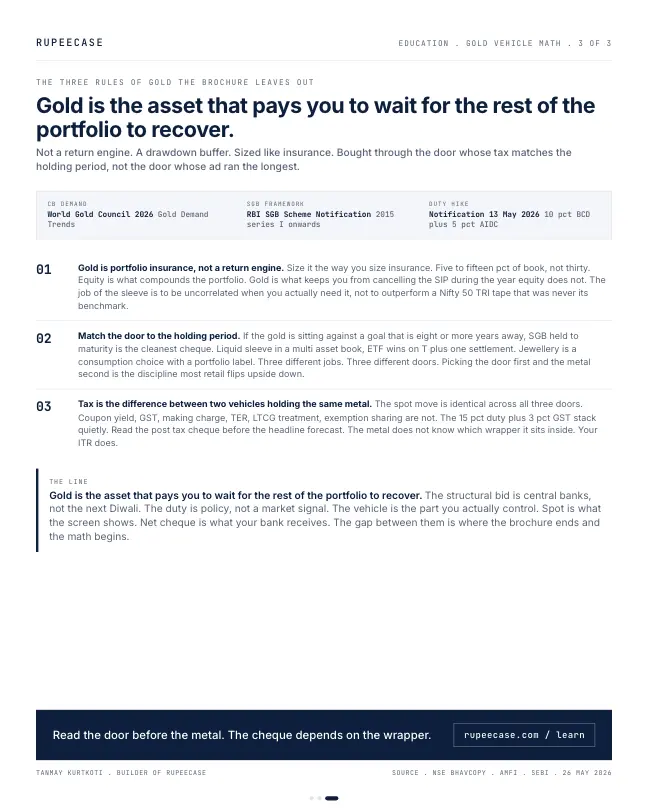
Three rules I keep coming back to. Gold is portfolio insurance, not a return engine. Size it five to fifteen pct of book. Match the door to the holding period. Tax is the difference between two vehicles holding the same metal.
Central banks bought roughly 1080 tonnes in 2025. The structural bid is policy, not the next Diwali. The duty is policy. The wrapper is the part you actually control.
Spot is what the screen shows. Net cheque is what your bank receives. The gap between them is where the brochure ends and the math begins
The doors changed in 2026
The figures above use the rules in force from 1 Apr 2026. Here is how the doors got there, and why one of them has mostly closed for new money.
- Sovereign Gold Bond Scheme starts
The RBI issues bonds in gold grams with a 2.5 percent yearly coupon.
- Last SGB tranche
No fresh SGB issue has been announced since, as of Oct 2026.
- Gold gains: 12.5 percent
Long term gains on gold taxed at 12.5 percent without indexation. Physical gold needs 24 months, listed units 12.
- Gold ETFs leave the debt fund rule
A specified mutual fund now means more than 65 percent in debt, so gold ETFs and gold funds get capital gains treatment again.
- SGB exemption narrowed
Tax free redemption only for bonds subscribed at original issue and held until maturity.
Two rules do most of the work. The Rs 1.25 lakh yearly exemption covers long term gains on listed equity, equity oriented funds and business trust units only, so a gold ETF's long term gain is taxed at 12.5 percent from the first rupee. And the SGB exemption now needs a bond bought at issue: one bought on the exchange pays the same coupon, but its gain at maturity is taxable.
The three doors, side by side
The working behind those figures: Rs 1,00,000, eight years, gold up 7 percent a year, an ETF expense ratio of 0.5 percent, and jewellery bought with 3 percent GST and a 12 percent making charge and sold back at 94 percent of the metal value. I added the 4 percent cess, taxed the SGB coupon at a 30 percent slab, and treated every gain as long term.
- SGB from issue, to maturityRs 1,85,579
- SGB bought on exchangeRs 1,76,242
- Gold ETF, sold at year 8Rs 1,56,985
- Jewellery, sold backRs 1,34,804
Worked example, Rs 1 lakh, gold +7% a year, 8 years. Coupon 2.5% on the issue price, taxed at 30% + 4% cess. Gains 12.5% + 4% cess, no Rs 1.25 lakh exemption. Rules per the Finance Bill 2026 and Finance (No. 2) Bill 2024 memoranda.
The coupon is taxable interest, which is why even the best door stops near Rs 1,85,600. The gap between the best and worst door is still about half the original capital.
Sizing the insurance
The opening's first rule is that gold is insurance, not an engine. In our own model lineup that idea shows up in the multi asset strategies, which carry a gold sleeve beside equity and debt. Their back tested maximum drawdowns are lower than the pure equity versions built on the same universe: Large Cap Multi Asset at minus 20.96 percent against Focused Largecap 20 at minus 23.56 percent, and Allcap Multi Asset at minus 21.32 percent against Allcap at minus 22.72 percent (Model, back tested, as of 27 Apr 2026). The sleeve does not make the ride smooth. It makes it a little less deep.
MythAny SGB is tax free at maturity, and gold ETFs get the Rs 1.25 lakh exemption.
FactFrom 1 Apr 2026 only SGBs bought at issue and held to maturity are exempt. The Rs 1.25 lakh exemption is for listed equity and equity funds, never gold.
The free Learn module on gold, commodities and international investing covers every gold wrapper available in India and how each is taxed. The asset allocation calculator shows how a 5 to 15 percent sleeve changes a portfolio's mix. Related: NPS, PPF, ELSS and the order that matters.
Questions readers ask
Is Sovereign Gold Bond maturity still tax free?
Only for bonds subscribed at the original issue and held continuously until maturity, under the rule in force from 1 Apr 2026. A bond bought later on the exchange pays the same coupon, but its gain at maturity is taxable as a capital gain. The 2.5 percent coupon is taxable at your slab in every case.
How is a gold ETF taxed in India?
Units held for more than 12 months are taxed at 12.5 percent on the long term gain, without indexation and without the Rs 1.25 lakh exemption, which applies only to equity. Units sold within 12 months are taxed at your slab rate.
Is buying gold jewellery a good investment?
As an investment it carries the highest costs of the common wrappers: 3 percent GST at purchase, a making charge that is usually lost on resale, and a resale price below the metal value. In the worked example it netted about Rs 51,000 less than an SGB held from issue to maturity.
The cards
3 cards. Swipe, or tap to open.
Explore next
Learn it properly, then see it applied.
- Free module 11.1Equity Taxation After July 2024: The New Rules10 min read
- StrategyAllcap strategyNifty Total Market, 50 stocks, every 2 weeks
- Free module 6.9Gold, Commodities, and International Investing for Indian Investors8 min read
- CalculatorAsset allocation by risk profileFree, with the formula and a worked example
- Blog topicPersonal finance and tax notes24 notes
Related
- NPS, PPF, ELSS: the order matters more than the rateThe Rs 50,000 NPS slot under 80CCD(1B) sits on top of the 80C ceiling, so a rate led picker leaves Rs 15,600 a year of saved tax on the table at the 30 percent slab.Personal finance and tax . . 5 min
- Term insurance: ten times income is the brochure ruleThe present value of a 35 year old's remaining earnings is about Rs 6.5 crore, not the Rs 2.5 crore a ten times income rule gives, and the extra cover costs about Rs 55 a day.Personal finance and tax . . 6 min
- Emergency fund: six months is the rule, the vehicle leaksSix months of expenses in a savings account at 3 percent loses to inflation, while a three tier split of savings, sweep FD and liquid fund earns 5.58 percent with the same liquidity.Personal finance and tax . . 5 min
Educational content only. Figures are illustrative and computed on historical or representative data for teaching purposes, not investment advice. Past performance does not guarantee future returns. Sourced from NSE, BSE, SEBI, AMFI and RBI public data.