

Company numbers..6 min read
A record low rupee redistributes, it does not subtract
With USD INR at 95.85, exporters earning in dollars gained on the revenue line while importers lost on the cost line and the neutral core did not move.
By Tanmay Kurtkoti, founder of QC Alpha and builder of RupeeCase
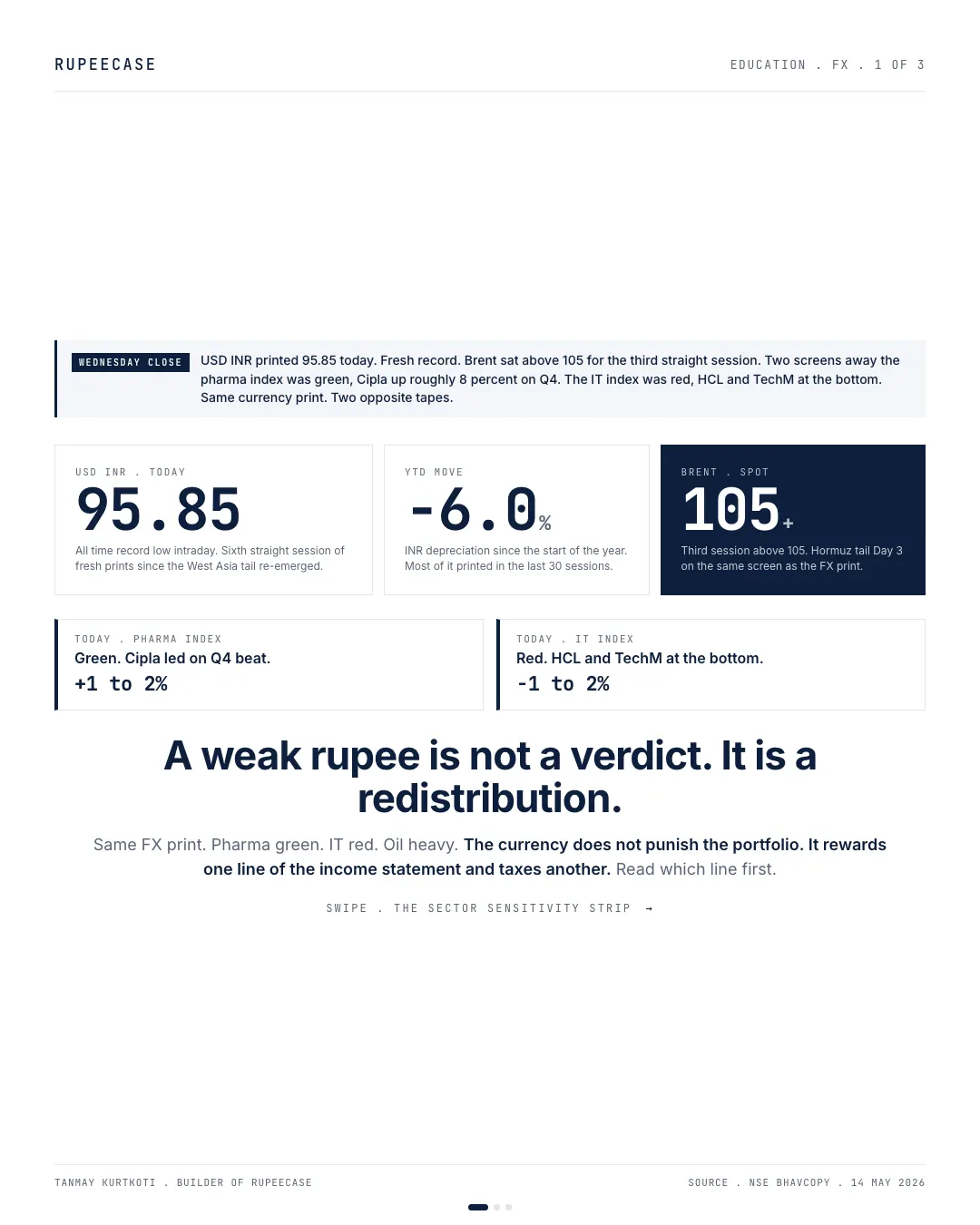
Wednesday at the desk. USD INR printed 95.85 today. Fresh record. Brent held above 105 for the third session running. Two screens away the Pharma index was green, Cipla up 8 percent on Q4. The IT index was red, HCL and Tech Mahindra at the bottom of the table.
Same currency print. Two opposite tapes.
Every group chat I am on woke up to a version of the same line. Rupee weak therefore portfolio bad. The actual screen disagreed in two opposite directions on the same day. That is the whole lesson.
The rupee is not a top of P&L event. It is a line item event.
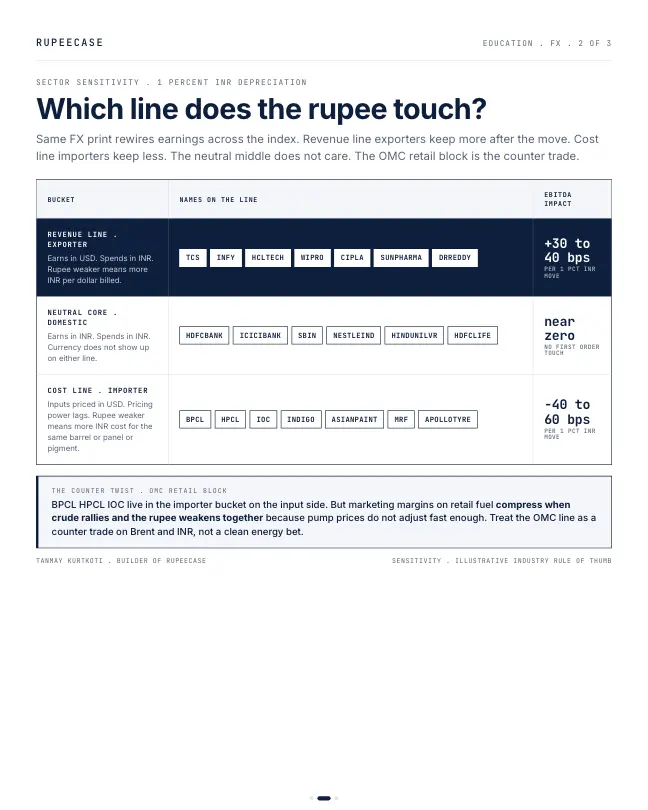
Three buckets on the same index.
Revenue line exporters. TCS, Infosys, HCL Tech, Wipro, Cipla, Sun Pharma, Dr Reddys. Earn in dollars. Spend in rupees. A weaker rupee means more INR per dollar billed without lifting a finger. The industry rule of thumb is roughly plus 30 to 40 basis points of EBITDA per 1 percent INR depreciation, more for the pure exporters.
Cost line importers. BPCL, HPCL, IOC, IndiGo, Asian Paints, MRF, Apollo Tyres. Inputs priced in dollars. Pricing power lags. A weaker rupee shows up in the cost of goods sold line inside the same quarter. Roughly minus 40 to 60 basis points the other way.
Neutral core. HDFC Bank, ICICI Bank, HUL, Nestle, HDFC Life. Earn in rupees. Spend in rupees. The currency does not show up on either line.
One catch worth saying out loud. The OMC retail block sits in the importer bucket on the input side, but marketing margins compress when crude rallies and the rupee weakens together because pump prices do not adjust fast enough. The OMC line is a counter trade on Brent and INR, not a clean energy bet.
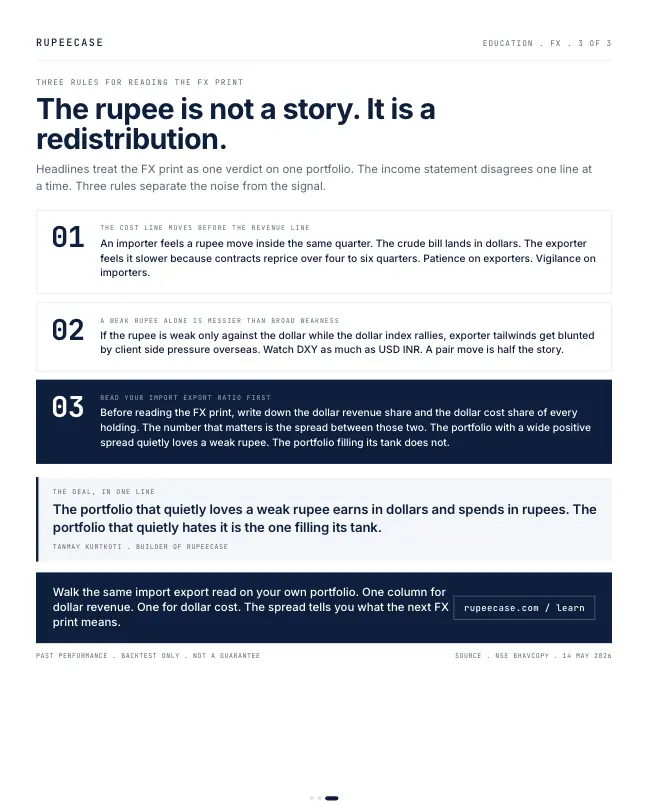
Three rules I keep coming back to. The cost line moves before the revenue line. A weak rupee against the dollar alone is messier than a broad weakness, watch DXY as much as USD INR. And write down the dollar revenue share and the dollar cost share of every holding before reading the next FX headline. The spread between those two is the number that matters.
The portfolio that quietly loves a weak rupee earns in dollars and spends in rupees. The portfolio that quietly hates it is the one filling its tank
How far the rupee moved in a year
The official benchmark for the dollar rate is the FBIL reference rate, which the RBI reprints in its Weekly Statistical Supplement. Here is the year to mid September 2026.
Rupees per US dollar, 19 Sep 2025
RBI WSS, FBIL reference rate
Rupees per US dollar, 18 Sep 2026
RBI WSS, 25 Sep 2026
More rupees for every dollar billed
95.79 / 88.31 minus 1
Read the same move two ways. A dollar now buys 8.5 percent more rupees. A rupee now buys 7.8 percent fewer dollars. An exporter feels the first number on its revenue line. An importer feels it on its cost line. A company that does neither barely feels it at all.
Put the two shares on paper
The opening's rule is to write down two numbers for every company: the share of revenue earned in dollars and the share of costs paid in dollars. Here are three hypothetical companies, each with Rs 100 of revenue.
Company A, an exporter, earns 80 percent of its revenue in dollars and pays 30 percent of its costs in dollars, for overseas staff and travel. Its operating margin is 25 percent, so costs are Rs 75. A 1 percent weaker rupee lifts revenue to Rs 100.80 and costs to Rs 75.23. The margin goes from 25.00 percent to about 25.37 percent: plus 37 basis points. That sits inside the opening's 30 to 40.
Company B, an importer, earns 5 percent of its revenue in dollars and pays half its costs in dollars, for imported raw material. Its margin is 15 percent. The same 1 percent move lifts revenue to Rs 100.05 and costs from Rs 85.00 to Rs 85.43. The margin falls about 38 basis points. Company C earns and spends only in rupees. Its margin does not move.
The year's move, run through all three
Now put in the actual 8.5 percent from the FBIL rates. Company A's margin rises from 25 percent to about 28 percent, close to 300 basis points. Company B's falls from 15 percent to under 12 percent, about 320 basis points. Company C's does not change.
- A, exporter+297 bps
- C, rupee in, rupee out0 bps
- B, importer-323 bps
Change in operating margin for an 8.47 percent rise in rupees per dollar (FBIL, 19 Sep 2025 to 18 Sep 2026, RBI WSS), before hedging and price changes. Worked example, not a company.
Real results move less than this, for two reasons. Exporters hedge part of their future dollars at fixed rates, so the gain arrives over several quarters. Importers raise prices, with a lag, and recover part of the cost. That is why the opening says the cost line moves first: the importer pays the new rate on its next shipment, while its price list changes later.
Finding the two shares in a filing
- Foreign exchange earned and spentThe Board's report states foreign exchange earnings and outgo for the year, as the Companies Act requires.
- Revenue by geographyThe segment note splits revenue between India and outside India.
- Currency risk noteThe financial instruments note gives open foreign currency exposure and the profit effect of a move in the rate.
- HedgesThe same note lists forward contracts and options, which delay the effect.
The currency risk note is the most useful line in the whole report for this question. Ind AS asks companies to show how much profit would change for a given move in the rupee. You do not need to guess. The free Learn module on the rupee, FII flows and global linkages covers why the rupee moves and how foreign flows feed into the Indian market. The post on Brent absorbers and amplifiers applies the same line by line reading to crude oil.
MythA weak rupee is bad for every Indian company.
FactIt moves money between companies. An exporter earning in dollars gains on its revenue line, an importer loses on its cost line, and a company that earns and spends in rupees sees little change.
Questions readers ask
How does a weaker rupee affect Indian companies?
It depends on which line the dollar touches. Exporters earning in dollars get more rupees per sale, so margins rise. Importers paying for inputs in dollars face higher costs, so margins fall until prices catch up. Companies that earn and spend in rupees are largely unaffected.
How much did the rupee fall against the dollar in the last year?
Using the FBIL reference rate printed in the RBI Weekly Statistical Supplement, the rate went from 88.31 rupees per dollar on 19 Sep 2025 to 95.79 on 18 Sep 2026. That is 8.5 percent more rupees per dollar, or a rupee worth 7.8 percent fewer dollars.
Where can I find a company's foreign currency exposure?
Three places in the annual report: foreign exchange earnings and outgo in the Board's report, revenue by geography in the segment note, and the currency risk sensitivity in the financial instruments note, which shows the profit effect of a given move in the rupee.
The cards
3 cards. Swipe, or tap to open.
Related
- Brent: absorbers, amplifiers and the OMC counter tradeA crude move hits upstream energy on the revenue line, aviation and paints on the cost line, and oil marketing companies the opposite way to ONGC despite the same sector tag.Company numbers . . 6 min
- Same net profit, two different quartersTwo companies printing Rs 245 crore of net profit collected Rs 220 crore and Rs 38 crore of operating cash, and the accruals gap is the line that does not negotiate.Company numbers . . 5 min
- DuPont: same ROE, three different businessesThree Nifty 200 stocks at 20 percent ROE got there by margin, by turnover and by a 4x equity multiplier, and only one of those levers survives a bad year cleanly.Company numbers . . 7 min
Educational content only. Figures are illustrative and computed on historical or representative data for teaching purposes, not investment advice. Past performance does not guarantee future returns. Sourced from NSE, BSE, SEBI, AMFI and RBI public data.