

Behaviour..5 min read
Mental accounting: the bonus that feels different
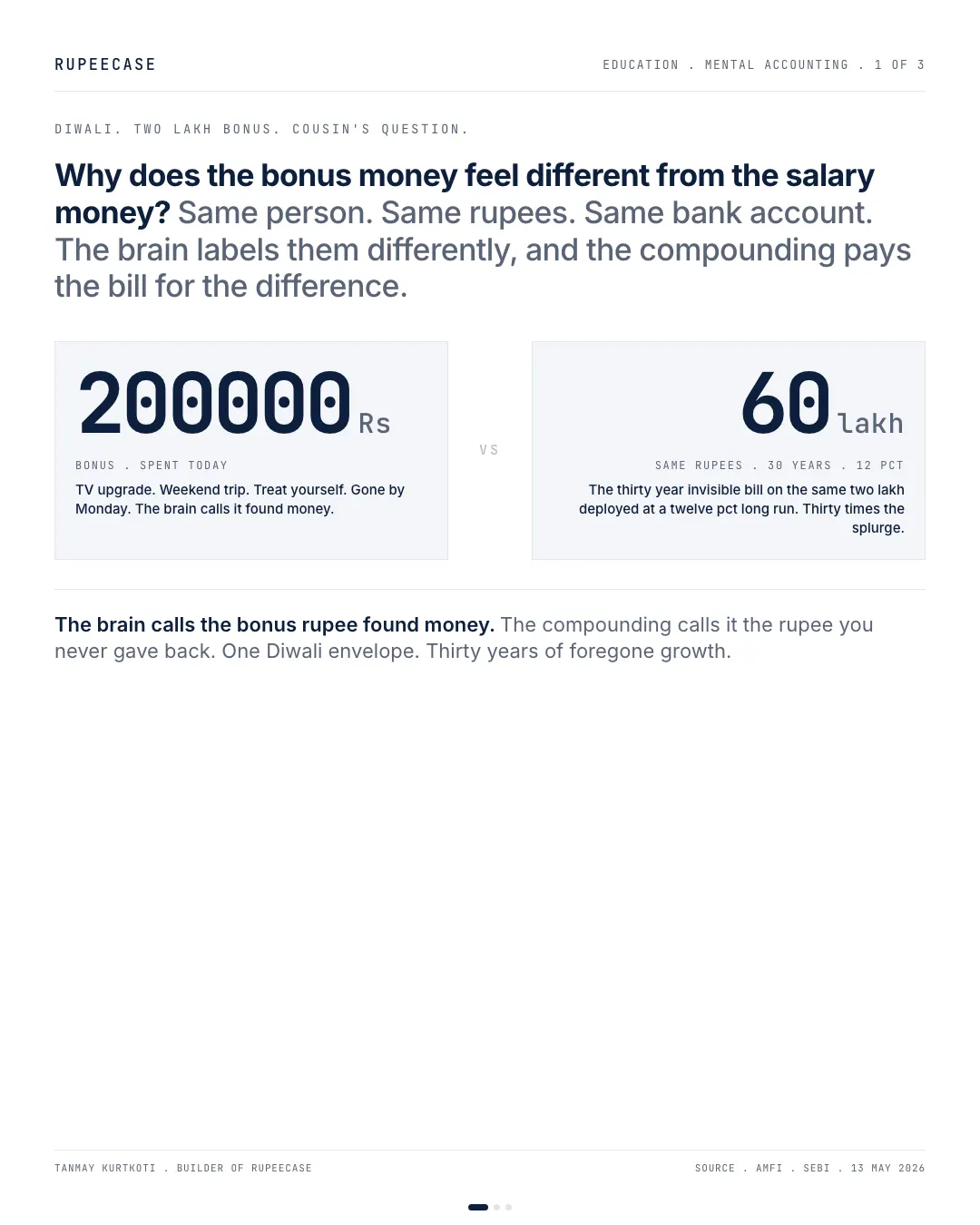
Thaler's mental accounting explains why a Diwali bonus gets spent and a salary SIP never misses, and a Rs 2 lakh splurge carries a thirty year bill of about Rs 60 lakh.
By Tanmay Kurtkoti, founder of QC Alpha and builder of RupeeCase
Cousin got his Diwali bonus last October. Two lakh straight in. The TV upgrade was done by Friday. Weekend trip by Sunday. Gone by Monday morning. The same cousin SIPs twenty five thousand from his salary every month for the last six years and has never missed. Asked him the obvious question over a cup of tea. Why does the bonus money feel different from the salary money.
It is not different. The brain just labels it differently.
Richard Thaler wrote the foundational paper on this in nineteen eighty five and won the Nobel for it in twenty seventeen. He called it mental accounting. We bucket money by source rather than by purchasing power. Salary feels earned and gets routed to the SIP. Bonus feels found and gets routed to the TV. Tax refund feels free and gets routed to a weekend. Diwali envelope feels for spending and gets spent. The wallet sees four buckets. The compounding sees one rupee.
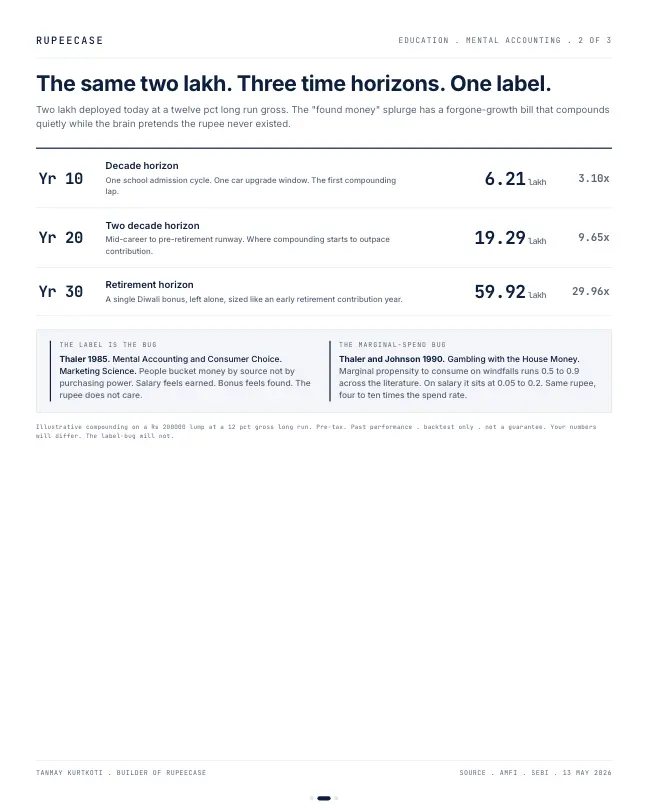
The math is easy to write down and hard to look at. Two lakh deployed at a twelve pct long run gross grows to roughly six point two lakh in ten years. Nineteen point three lakh in twenty. Sixty lakh in thirty. One bonus splurge has a thirty year invisible bill of roughly thirty times the splurge.
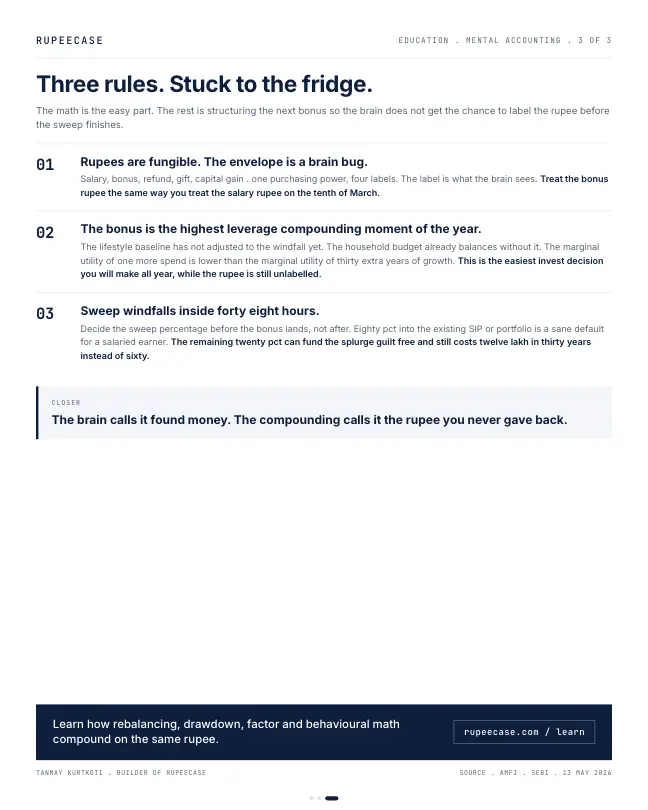
Three rules I would put on the fridge.
Rupees are fungible. The label on the envelope is a brain bug not a feature.
The bonus is your highest leverage compounding moment of the year. The lifestyle baseline has not adjusted to it yet. The household budget already balances without it.
Sweep windfalls into the existing SIP or portfolio inside forty eight hours. Before the brain finishes labelling the rupee as found money. Decide the sweep amount before the bonus lands, not after.
The brain calls it found money. The compounding calls it the rupee you never gave back
The taxman does not keep separate envelopes
First, the opening's arithmetic as a picture, so the thirty year bill is not just a sentence.
- TodayRs 2.00 L
- After 10 yearsRs 6.21 L
- After 20 yearsRs 19.29 L
- After 30 yearsRs 59.92 L
Worked example at an illustrative 12% a year, compounded yearly, before tax.
Here is the cleanest proof that the bonus is not special money. The Income-tax rules do not see it as special either. A bonus is part of salary. It is added to the rest of your income for the year and taxed at your slab rate, with no separate bucket.
Under the default new regime for tax year 2026-27 (section 202 of the Income-tax Act 2025, in force from 1 Apr 2026), the slabs run from nil up to Rs 4 lakh, then 5, 10, 15, 20 and 25 percent, and 30 percent above Rs 24 lakh. A 4 percent health and education cess is added to the tax.
Take someone with Rs 18 lakh of taxable income before the bonus. The Rs 2 lakh bonus takes that to Rs 20 lakh, so all of it falls in the 20 percent slab. Tax on the bonus: Rs 40,000, plus 4 percent cess, Rs 41,600. The bonus that lands in the account is Rs 1,58,400, not Rs 2 lakh.
So the honest version of the opening's sum is a little smaller and still large. Rs 1,58,400 at 12 percent for 30 years is about Rs 47.5 lakh. The splurge's thirty year bill is about thirty times the money that actually arrived.
The tax refund is your own money coming back
The refund is the most mislabelled rupee of the year. A refund is not a gift. It is tax you paid in excess, through TDS or advance tax, returned after the return is processed. You lent it to the government, interest free for most of the year, and now it is back. Labelling it "free" is the exact bug Thaler described.
MythA tax refund is a bonus, so it is fine to spend it.
FactA refund is your own salary, over deducted and returned. It is the same rupee that would have gone to the SIP if it had not been withheld.
One rupee, four labels
The opening lists four buckets. Here they are next to the one bucket compounding sees. Each label changes the behaviour. None changes what the rupee can buy or what it can grow into.
Making the sweep automatic
Rule three works because it removes the decision from the moment the money arrives. The sequence below is the one I would write down before bonus season, so that the label never gets a chance to stick.
- Before it landsWrite the split: for example half to the portfolio, half to spend.
- Check the netWork out the bonus after slab tax and cess, so the split is on real rupees.
- Within 48 hoursMove the invest half into the existing SIP fund or portfolio.
- Then spendThe spend half is guilt free, because the decision was made in advance.
A half and half rule still pays for the TV. It also puts about Rs 79,200 to work from a Rs 2 lakh bonus at the 20 percent slab, which at the same illustrative 12 percent is about Rs 23.7 lakh in 30 years. The lump sum calculator runs it for any amount and horizon.
The free Learn module Why investors lose puts mental accounting next to the other biases that cost ordinary investors the most. Two related posts: anchoring on the buy price and the sunk cost trap.
Questions readers ask
Is a bonus taxed differently from salary in India?
No. A bonus is part of salary income and is taxed at your slab rate along with the rest of your income for the year. Under the new regime for tax year 2026-27, a Rs 2 lakh bonus that falls in the 20 percent slab costs Rs 41,600 after the 4 percent cess.
What is mental accounting?
It is Richard Thaler's term for treating money differently depending on where it came from or what it is labelled for. Salary goes to savings, a bonus or refund gets spent, even though every rupee buys and compounds the same.
Is an income tax refund extra income?
No. A refund returns tax that was deducted or paid in excess of what you owed. It is your own income coming back, so treating it as free money is a labelling error, not a gain.
The cards
3 cards. Swipe, or tap to open.
Explore next
Learn it properly, then see it applied.
Related
- Who told the stock your buy priceOdean's 1998 study found investors cut winners 51 percent faster than losers, and a Rs 1 lakh position left flat for five years forgoes Rs 76,234 of compounding.Behaviour . . 5 min
- Recency bias meets factor crowdingA model basket up 60 percent on a trailing return screen is a momentum tilt with a friendly name, and the same factor has lost 28, 21 and 19 percent in its three crashes.Behaviour . . 6 min
- Sunk cost: the first loss is the cheapestA 35 percent hole needs 54 percent to climb out, and a Rs 65,000 rump held flat for three years forgoes about Rs 30,000 against cutting and redeploying at the index.Behaviour . . 5 min
Educational content only. Figures are illustrative and computed on historical or representative data for teaching purposes, not investment advice. Past performance does not guarantee future returns. Sourced from NSE, BSE, SEBI, AMFI and RBI public data.