

Costs: MF, PMS, RupeeCase..6 min read
Two week rebalancing and the STCG objection
A 60 percent higher short term tax rate loses to a 192 percent higher gross return, so compare after tax cheques on the same corpus rather than tax brackets.
Model, back tested, as of 27 Apr 2026, as published then; the strategy page shows the current figure.
By Tanmay Kurtkoti, founder of QC Alpha and builder of RupeeCase
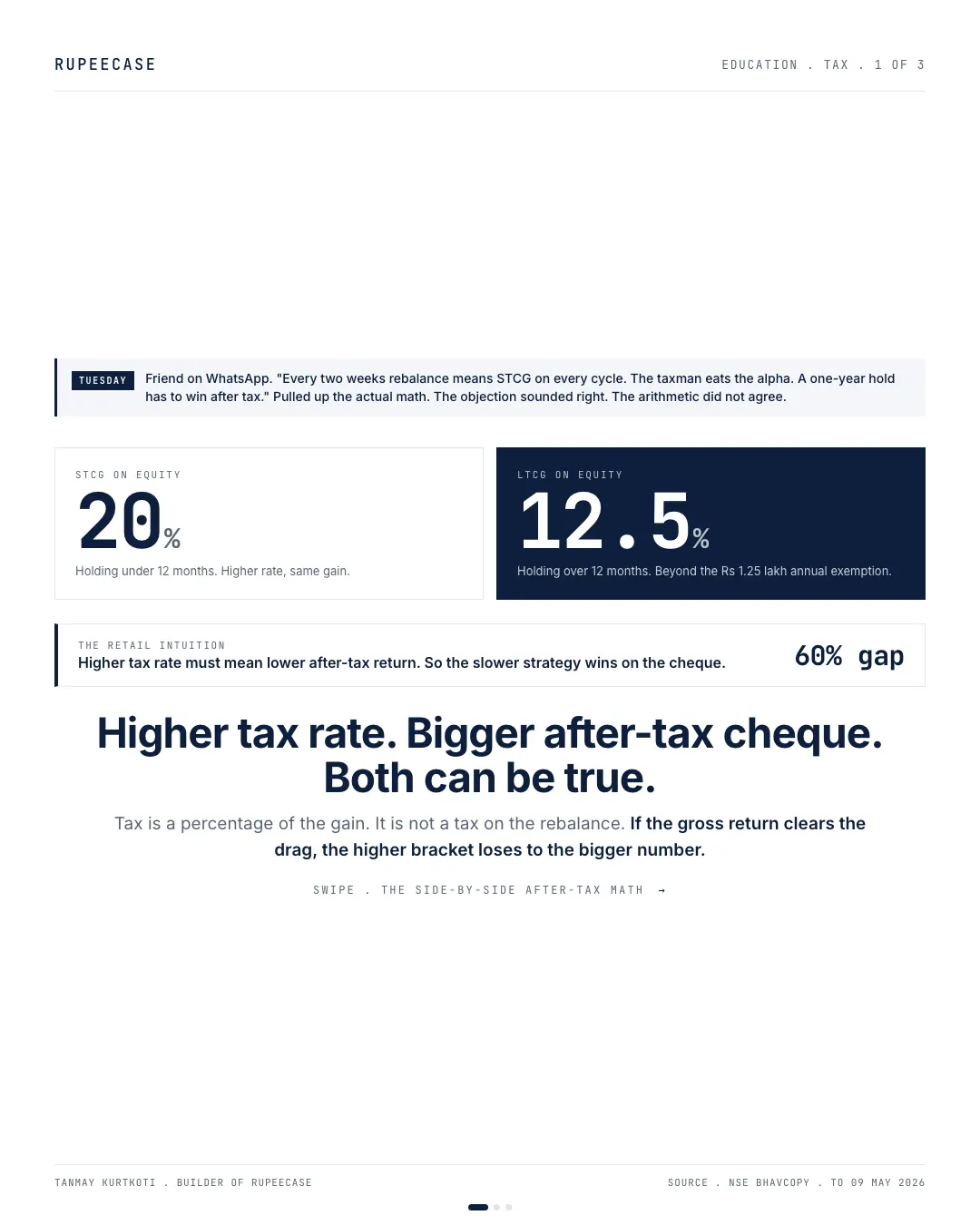
Friend pinged on Tuesday evening with the same objection I have heard maybe fifty times now. "Every two weeks rebalance means you pay STCG on every cycle. The taxman eats the alpha. A one year hold has to win after tax."
The first half of that is correct. The leap to the verdict is not.
Pulled up the math.
Short-term capital gains on equity, 20 percent. Long-term capital gains on equity, 12.5 percent beyond the Rs 1.25 lakh annual exemption. The short-term bracket is a 60 percent higher rate. That is the part the objection gets right.
Then run the two strategies on the same Rs 10 lakh, one year forward, with realistic gross returns.
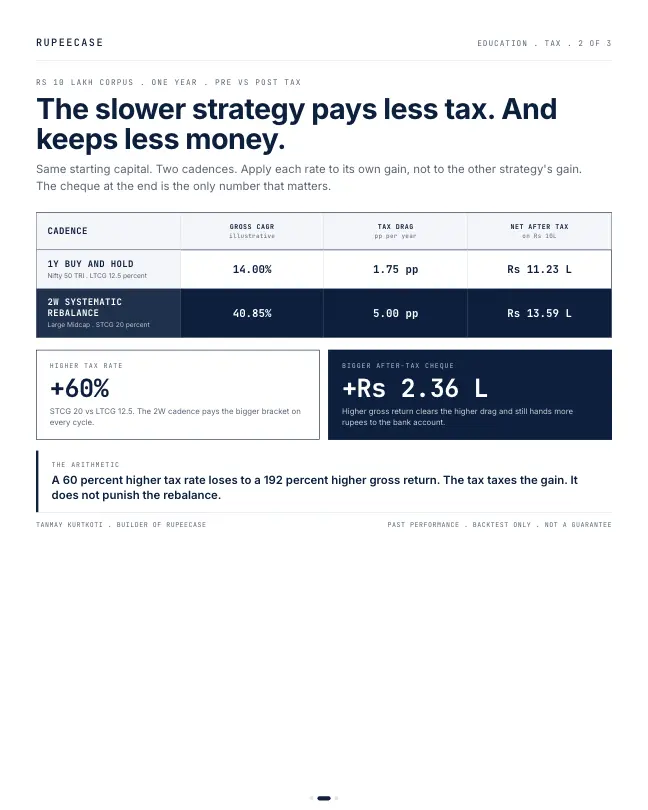
A one year buy-and-hold of the Nifty 50 TRI sits on roughly 14 percent gross long-run. Net of LTCG drag at 12.5 percent on the gain above the exemption, the cheque is around Rs 11.23 lakh. Tax drag is light. Return is light. Both are light.
A 2-week systematic rebalance on a five year backtest of the Large Midcap engine sits around 40.85 percent gross CAGR. Net of STCG drag (roughly five percentage points off the top once you tax every realised cycle at 20 percent), the cheque is around Rs 13.59 lakh. Tax drag is heavier. The cheque is heavier by more.
The bigger bracket hands Rs 2.36 lakh more to the bank account in the same year.
The arithmetic is simple. A 60 percent higher tax rate loses to a 192 percent higher gross return every single time. The tax is a percentage of the gain. It is not a tax on the rebalance.
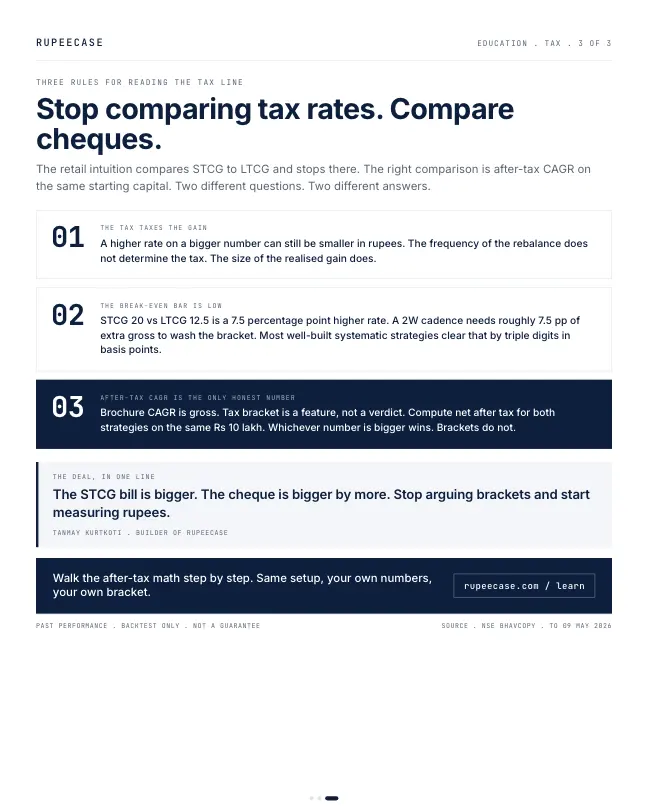
Honest version: stop comparing tax rates. Compare after-tax cheques on the same corpus. Whichever number is bigger wins. Brackets do not
The rules, as they stand in Oct 2026
Three numbers decide almost everything for listed shares and equity funds. They came in with the Finance (No. 2) Act 2024 for sales on or after 23 Jul 2024, and the Income-tax Act, 2025 kept the same rates from 1 Apr 2026.
Short term gains, held 12 months or less
Finance (No. 2) Act 2024, from 23 Jul 2024
Long term gains, held more than 12 months
Finance (No. 2) Act 2024, from 23 Jul 2024
Long term gains exempt each financial year
Finance (No. 2) Act 2024, from 23 Jul 2024
These are rates before surcharge and cess, and they apply only to STT paid listed equity, equity funds and business trusts. The free Learn module on tax efficient portfolio construction covers the rest, including where debt and gold sit.
What a fortnightly rebalance actually taxes
The objection pictures the whole portfolio being sold every two weeks. That is not how a rebalance works. Only the stocks that leave the list are sold. A name that stays in the top ranks for eighteen months is never sold, so it is never taxed, and if it is eventually sold after twelve months it is a long term gain.
- The list changesA few names drop out of the ranking on rebalance day. The rest stay untouched.
- Only the exits are soldNo sale, no tax. The names that stay keep compounding untaxed.
- Each sale is sorted by holding period12 months or less is short term at 20 percent; more than 12 months is long term at 12.5 percent.
- Losers offset winnersA short term loss can be set off against short or long term gains in the same year.
- Tax is on the net gainUnused losses carry forward for eight years if the return is filed on time.
That fourth step matters more than people expect. A momentum rule sells its losers fast, so it books losses as well as gains. Those losses reduce the taxable gain in the same year, as the Income Tax Department's FAQ on set off of losses lays out.
The fair test: same gross return, then the break even
The opening compares two different gross returns. That is half the test. The other half is: if both earned the same gross return, how much does churn cost, and how much extra return does churn need just to tie?
Worked example. Rs 10,00,000, 15 percent a year gross, five years.
- Hold for five years. The corpus grows to Rs 20,11,357. The gain is Rs 10,11,357. Take out the Rs 1,25,000 exemption: Rs 8,86,357 is taxable. Tax at 12.5 percent is Rs 1,10,795. You keep Rs 19,00,563.
- Churn every year. Assume every rupee of gain is realised short term each year at 20 percent. The 15 percent becomes 12 percent after tax, compounding for five years: Rs 17,62,342.
- The cost of churn at equal gross: Rs 1,38,221. That is the real tax drag, and the objection is right to worry about it.
- The break even: churn ties the holder at a gross return of about 17.1 percent. Above that, churn leaves more money; below it, holding does.
So the question is never "is 20 more than 12.5". It is "does the active approach beat the passive one by more than about 2 points a year, after its own costs". Change the inputs and see where your break even lands.
Here is the same example as three cheques, plus one more line: churn at 20 percent gross.
- Churn at 15%, after taxRs 17.62 L
- Hold at 15%, after taxRs 19.01 L
- Churn at 20%, after taxRs 21.00 L
Rs 10 lakh for 5 years. Worked example, not a forecast. STCG 20%, LTCG 12.5% above Rs 1.25 lakh, from 23 Jul 2024.
For reference, the Large Midcap card the opening talks about now shows 37.83 percent CAGR and a minus 19.31 percent max drawdown on the current lineup (Model, back tested, as of 27 Apr 2026). A past model return is not a promise, so the honest use of the break even is as a hurdle: whatever approach you pick has to clear it, year after year, after tax.
Where holders leave money on the table
Holding has its own leak. The Rs 1.25 lakh exemption is per financial year, and a holder who sells once in year five gets it once. Booking up to that much long term gain every year and buying back resets the cost base for free. The exemption you throw away runs that math, and the two week rebalance explainer shows why the calendar exists at all. The capital gains tax calculator works out the tax on any single sale.
Questions readers ask
Is STCG charged every time a portfolio is rebalanced?
No. Tax applies only to the shares actually sold, and only on the gain. On a rebalance, the stocks that stay in the portfolio are not sold, so nothing is taxed on them. A sale held 12 months or less is taxed at 20 percent, more than 12 months at 12.5 percent above the Rs 1.25 lakh yearly exemption.
What is the short term capital gains tax on shares in India in 2026?
20 percent on listed equity shares and equity funds held 12 months or less, where STT is paid, for sales on or after 23 Jul 2024. The rate continues under the Income-tax Act, 2025 from 1 Apr 2026. Surcharge and cess are added on top depending on income.
Can short term capital losses reduce long term capital gains tax?
Yes. A short term capital loss can be set off against both short and long term capital gains, while a long term loss can only be set off against long term gains. Unused losses can be carried forward for eight years, but only if the return for the loss year is filed by the due date.
The cards
3 cards. Swipe, or tap to open.
Explore next
Learn it properly, then see it applied.
- Free module 6.3Mutual Funds, Structure, Types and Hidden Costs8 min read
- CalculatorTax loss harvestingFree, with the formula and a worked example
- Free module 11.6Tax-Efficient Portfolio Construction8 min read
- CalculatorLTCG and STCG on equityFree, with the formula and a worked example
- StrategyLarge Midcap strategyNifty LargeMidCap 250, 40 stocks, every 2 weeks
- Blog topicCosts: MF, PMS, RupeeCase notes25 notes
Related
- Large Midcap: when the return is a tie, the drawdown decidesLarge Midcap, Smallcap and Microcap all printed about 41 percent, with holes of 19.30, 22.35 and 26.44 percent, and only the first finished 2025 up.Strategy notes . . 5 min
- The Rs 1.25 lakh you throw away every yearRealising gains yearly in your own name beats deferring to exit up to about Rs 60 lakh of portfolio, because ten shots at the exemption are worth Rs 1,56,250 of tax.Costs: MF, PMS, RupeeCase . . 14 min
- The cadence question: why two weeksRupeeCase Large Midcap rebalanced 131 times in five years at a 14 day average gap, a cadence chosen to stop a momentum signal rotting without paying quarterly latency.Strategy notes . . 5 min
Educational content only. Figures are illustrative and computed on historical or representative data for teaching purposes, not investment advice. Past performance does not guarantee future returns. Sourced from NSE, BSE, SEBI, AMFI and RBI public data.