

Behaviour..5 min read
FII flow is a sentence, not a verdict
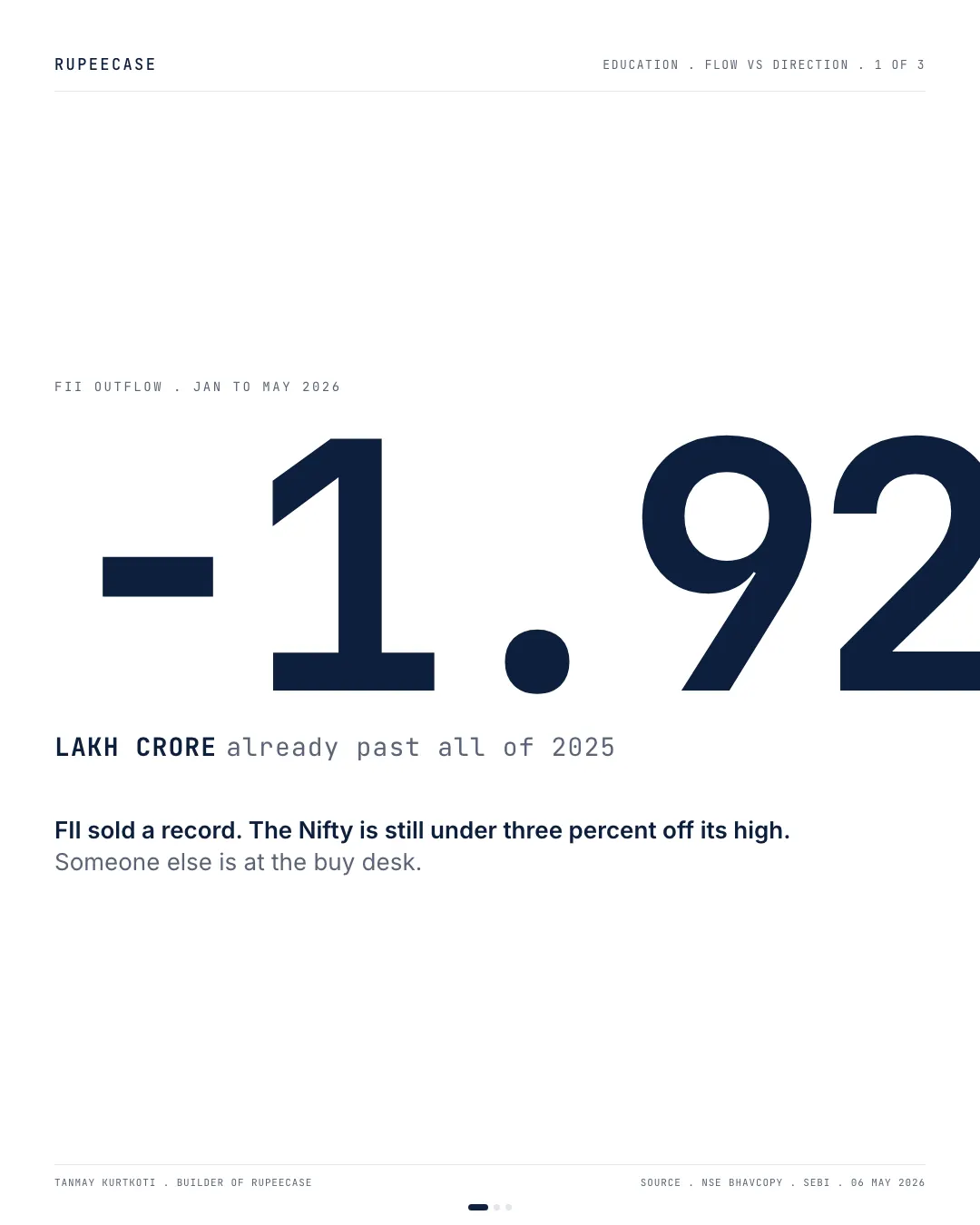
FII sold Rs 1.92 lakh crore of Indian equity in four months of 2026 while the Nifty sat 7.6 percent off its high, because DII and the SIP book were the bigger buyer.
By Tanmay Kurtkoti, founder of QC Alpha and builder of RupeeCase
Got a message yesterday. Smart guy, runs his own portfolio. He had read that FII outflows in 2026 just crossed the entire 2025 number, and he was asking whether he should be selling.
I pulled the ledger before answering.
Four months in, FII has sold one point nine two lakh crore in Indian equity. Bigger than all of 2025 (one point six six lakh crore). And the Nifty closed at twenty four thousand three hundred thirty one on 6 May 2026, about 7.6 percent below its 2 January high on NSE closes. A record outflow, and the index is down single digits. The flow line says crisis, the price line says we are nowhere near one.
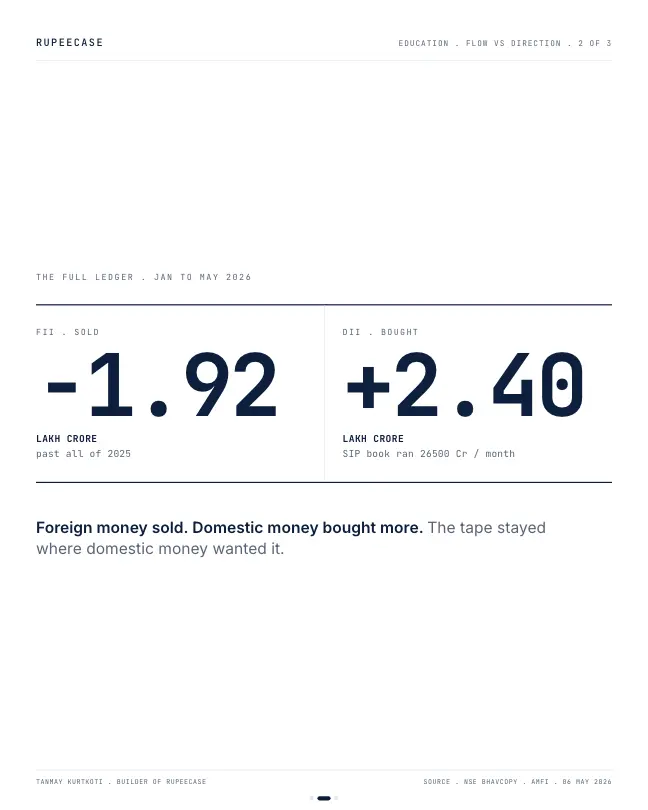
The full ledger explains the gap. DII has bought two point four lakh crore over the same period, the SIP book alone is running at twenty six thousand five hundred crore a month across eleven point four crore live accounts. For the first time ever, domestic ownership of NSE-listed equity is above foreign ownership. The marginal price-setter is no longer a hedge fund in Singapore. It is your neighbour on a 25,000 rupee SIP. rupeecase.com/learn/
This is where most flow commentary breaks. FII selling concentrates in liquid largecaps, the exact same names the SIP book is rebuying every week. Specific tickers can lose ten percent on an outflow week. The Nifty index does not, because the structural buyer is bigger and slower than the tactical seller. Stock pain and index pain stop being the same problem. rupeecase.com/stocks/
So the rules I keep on the desk for any week the flow story makes the front page.
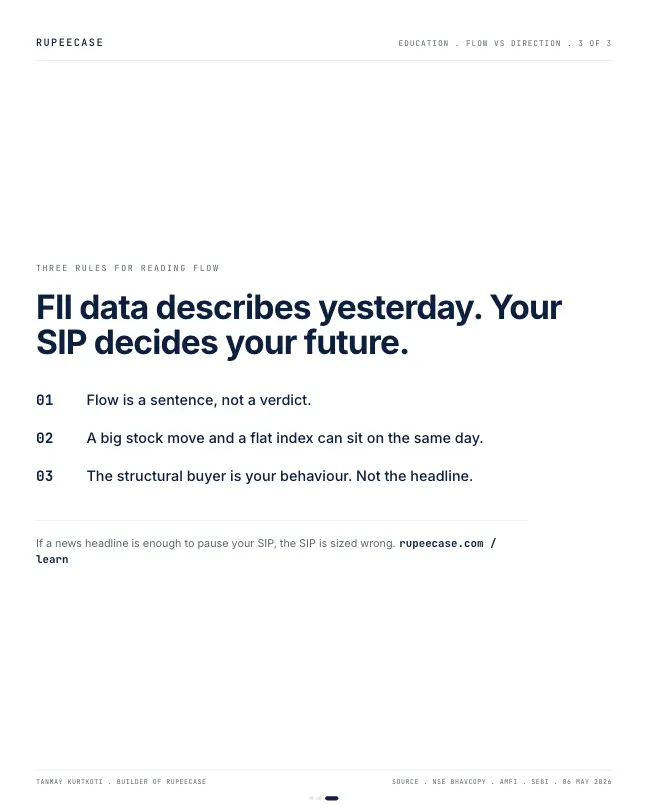
One. Flow is a sentence, not a verdict. If a number tells you only who sold, not who bought, it is incomplete.
Two. A big stock move and a flat index can sit on the same day. They are different problems.
Three. The structural buyer is your behaviour. The day an FII headline is enough to make you pause your SIP, the SIP is sized wrong. Run a risk profile first, size the SIP for the worst week you will face. rupeecase.com/risk-profile
FII data is a description of yesterday. Your SIP is a decision about your future. Only one of those is signal. rupeecase.com/
Every sale has a buyer
Start with the one identity that flow headlines leave out. On an exchange, every share sold is a share bought. If foreign investors sold Rs 1.92 lakh crore, somebody bought Rs 1.92 lakh crore at a price both sides agreed. The flow figure tells you who was on which side. It does not tell you how far the price had to move to get the trade done.
That is why a record outflow and a fairly calm index can sit in the same four months. When the buyer on the other side is large, patient and arrives on a schedule, the seller does not need to knock the price down much to find him.
- Foreign sellerSells a liquid large cap to cut India exposure.
- Order bookThe sale meets standing bids on NSE at a slightly lower price.
- Domestic buyerFund houses deploy that day's SIP cash into the same names.
- The printFII net sold, DII net bought, the index moves far less than the headline.
What the price line actually did
The two years around that week tell the same story on NSE's own closing levels.
The Nifty 50 closed Oct 2024 at 24,205, had its highest month end close, 26,203, at the end of Nov 2025 and ended Sep 2026 at 22,620.
NSE, Nifty 50 month end closes, Oct 2024 to Sep 2026 (NSE bhavcopy data). Price index, no dividends.
The chart has two real dips in it: Feb 2025, when the index closed at 22,125, and Mar 2026, when it closed at 22,331 after an 11.3 percent month. The deepest fall from a peak in this window was 15.6 percent, from 26,328.55 on 2 Jan 2026 to 22,231.80 on 8 Oct 2026. Those are the weeks the flow story was loudest. They are also the weeks a SIP bought the most units per rupee.
The buyer who arrives on a calendar
The domestic side of the ledger has grown since this post went out. AMFI's monthly data for Aug 2026 shows the SIP book larger than the figures in the opening.
collected through SIPs in Aug 2026
AMFI, Aug 2026
SIP accounts that contributed in Aug 2026
AMFI, Aug 2026
SIP assets at the end of Aug 2026
AMFI, Aug 2026
Spread Rs 32,297 crore across about 21 trading days and roughly Rs 1,538 crore of fresh SIP money needs a home every session. It does not read the flow headline before it lands. That is the structural buyer in the opening, in numbers.
MythHeavy FII selling means the index has to fall hard.
FactEvery sale has a buyer. When domestic SIP money is the buyer, the price can absorb a record outflow with a single digit move, as the Nifty did in the first months of 2026.
Sizing the SIP for the worst week
Rule three in the opening is the one that matters for your own account. The useful question is not what foreign investors will do next week. It is how many rupees you can watch disappear without stopping the SIP. Put your own numbers in. The default fall is the 15.6 percent peak to trough move on the Nifty 50 in this window.
If Rs 1,40,400 on the screen would make you stop the SIP, the mix is too aggressive for you, whatever a questionnaire said on a calm day. The free Learn module on INR, FII flows and global linkages covers how foreign flows, the rupee and domestic money interact, and the companion post on reading a flow print walks through the daily FII and DII release.
Questions readers ask
Does FII selling make the Nifty fall?
Not by itself. Every share sold is bought by someone, and in 2026 domestic funds fed by about Rs 32,297 crore a month of SIP money (AMFI, Aug 2026) were the main buyer. The index fell 15.6 percent from its Jan 2026 high to its Oct 2026 low on NSE closes, far less than the size of the outflow headlines suggested.
Where can I see daily FII and DII figures?
NSE publishes provisional FII and DII cash market figures after the close on each trading day. They tell you who was a net buyer or seller yesterday. They do not say which stocks were traded or what happens next.
How much SIP money comes into Indian equity each month?
AMFI's data shows Rs 32,297 crore collected through SIPs in Aug 2026, from 10.02 crore contributing accounts. Split over about 21 trading days, that is roughly Rs 1,538 crore of new money a session.
The cards
3 cards. Swipe, or tap to open.
Explore next
Learn it properly, then see it applied.
- Free module 8.1Why Investors Lose, Introduction to Behavioural Finance11 min read
- StrategyAllcap strategyNifty Total Market, 50 stocks, every 2 weeks
- Free module 7.4INR, FII Flows, and Global Market Linkages10 min read
- CalculatorSIP calculatorFree, with the formula and a worked example
- Blog topicBehaviour notes27 notes
Related
- FII flow: signal or noiseThe day FII turned buyer and DII turned seller the Nifty slipped 0.14 percent, because a flow print is a record of yesterday and never a verdict on tomorrow.Behaviour . . 5 min
- Stops set by feel, not by mathA 10 percent trailing stop on an ordinary large cap gets hit four to six times a year by normal weather, and each forced round trip costs about 0.30 percent.Behaviour . . 6 min
- Who told the stock your buy priceOdean's 1998 study found investors cut winners 51 percent faster than losers, and a Rs 1 lakh position left flat for five years forgoes Rs 76,234 of compounding.Behaviour . . 5 min
Educational content only. Figures are illustrative and computed on historical or representative data for teaching purposes, not investment advice. Past performance does not guarantee future returns. Sourced from NSE, BSE, SEBI, AMFI and RBI public data.