

Personal finance and tax..5 min read
Rent vs buy: the two numbers the dead money line skips
More than 80 paise of a first year EMI rupee is interest, rent runs about 3.5 percent of price against an 8.5 percent loan, and the down payment has an opportunity cost.
By Tanmay Kurtkoti, founder of QC Alpha and builder of RupeeCase
A friend told me over the weekend that renting is throwing money away. He wants to buy a flat. Fair instinct, most of us grew up hearing it.
So I pulled the actual numbers on a one crore apartment.
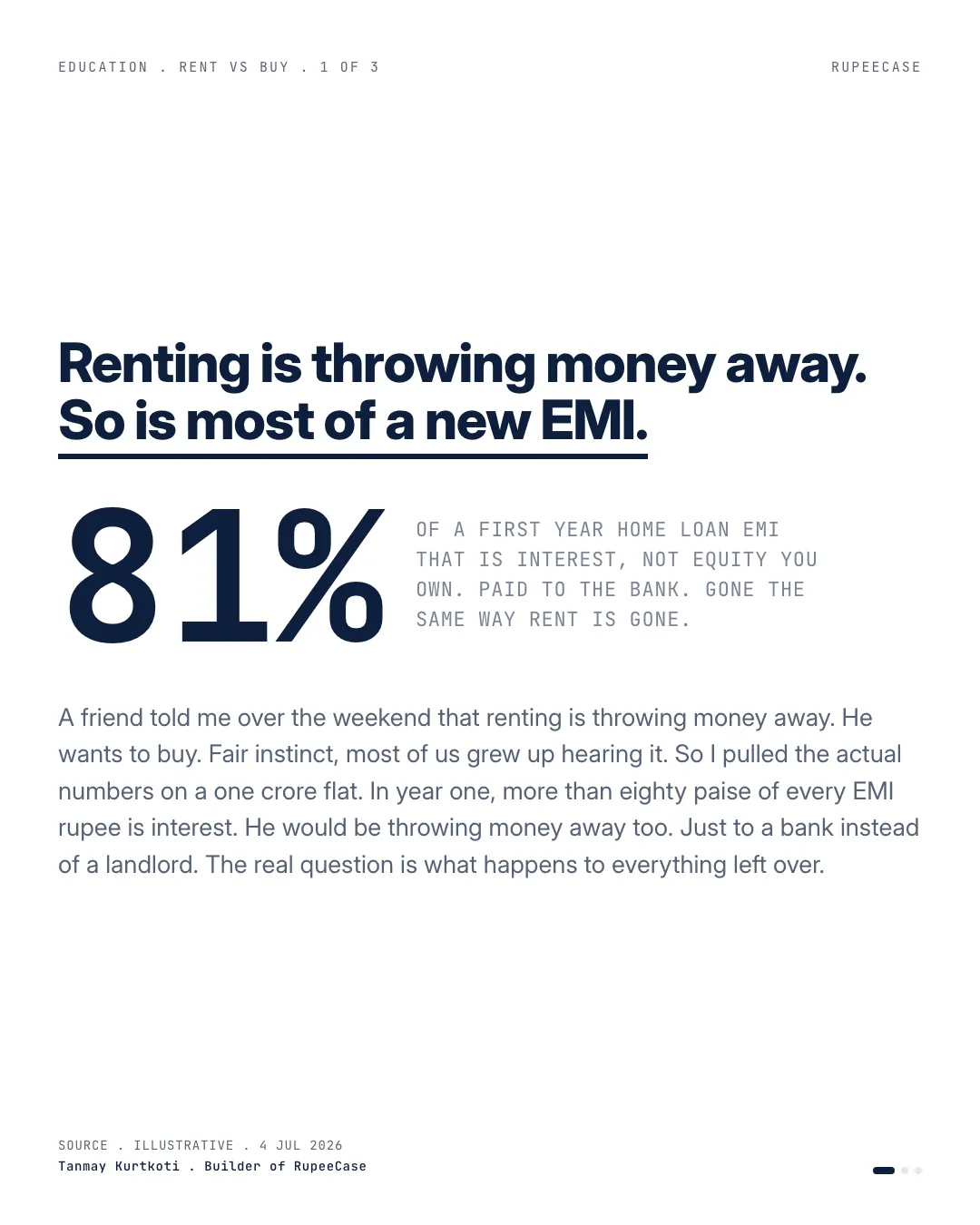
Here is the part that stops the argument. In the first year of a home loan, more than eighty paise of every EMI rupee is interest. Not equity you own. Interest, paid to the bank, gone the same way rent is gone. The buyer is throwing money away too, at least early on. Just to a different landlord.
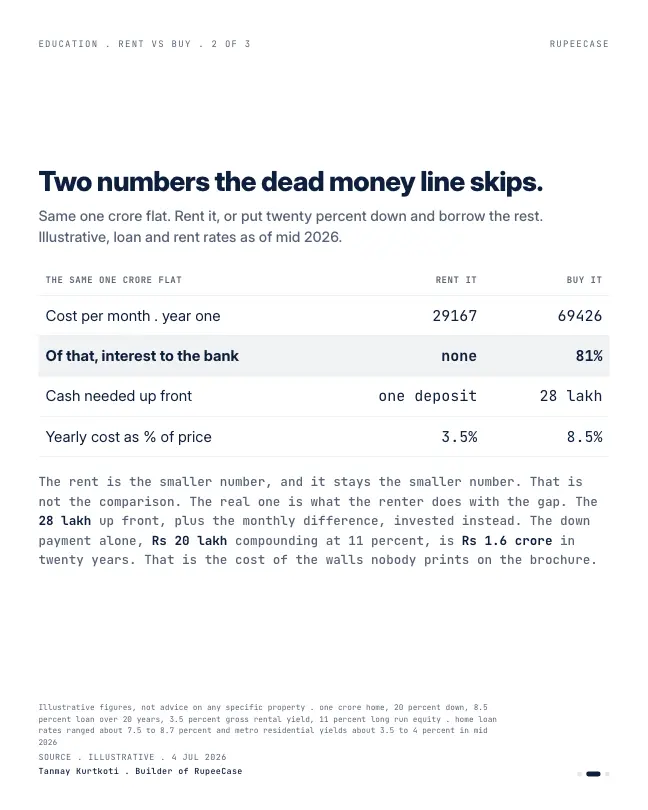
Now the comparison people skip. You can rent a metro flat for roughly 3.5 percent of its price a year. Borrowing to buy the same flat costs about 8.5 percent. That five point gap is the running cost of owning, before maintenance, before property tax, before the eight percent in stamp duty and paperwork you pay just to walk in the door.
And the down payment. Twenty lakh, sitting in walls instead of the market. That same twenty lakh, invested at eleven percent, is about 1.6 crore in twenty years. That is the number nobody writes on the brochure.
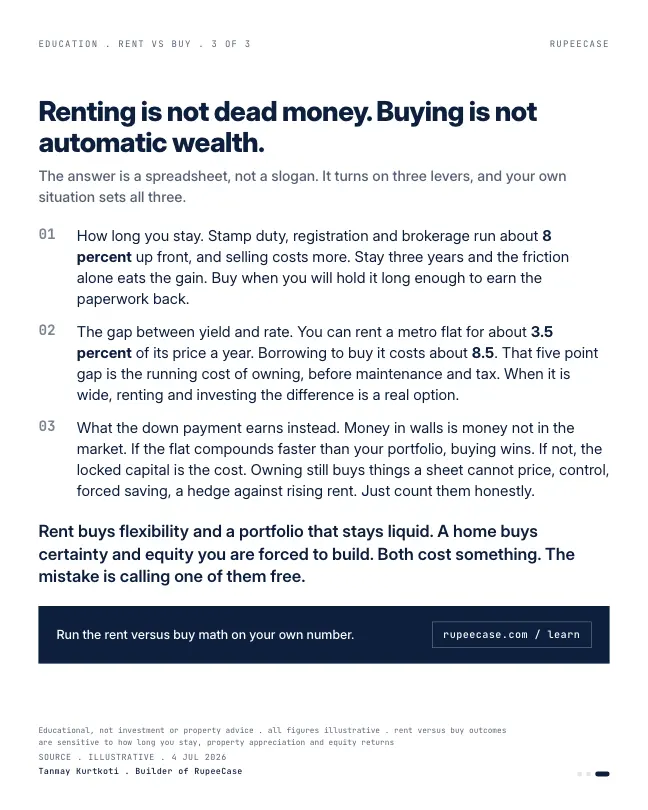
This is not me telling you to rent. If the flat compounds faster than your portfolio, buying wins outright. And a home buys things a spreadsheet cannot price. A place you control. A forced savings plan you cannot skip. A hedge against rent that keeps climbing.
The honest version is that both cost something. Rent buys flexibility and a portfolio that stays liquid. A home buys certainty and equity you are forced to build. The mistake is calling either one free.
It turns on three levers: how long you will stay, the gap between yield and loan rate, and what the down payment would earn elsewhere. Run your own number before the EMI runs it for you
The first year of EMIs, checked
The opening's eighty paise is easy to verify. A Rs 1 crore flat with Rs 20 lakh down leaves an Rs 80 lakh loan. At 8.5 percent for 20 years the EMI is Rs 69,426. In the first 12 months you pay Rs 8,33,110, and the split is lopsided.
- Interest in year oneRs 6,73,892
- Principal repaid in year oneRs 1,59,218
Worked example: Rs 80 lakh loan, 8.5% a year, 240 monthly EMIs of Rs 69,426.
Compare the interest with the rent on the same flat. At 3.5 percent of the price, rent is about Rs 3,50,000 a year. The buyer's interest alone is Rs 6,73,892, nearly double, before maintenance, property tax and the return the Rs 20 lakh down payment could have earned.
The number that decides it: break even growth
Here is the cleanest way to put both sides on one line. Add up what owning costs you in a year that renting does not: interest, upkeep and the return the down payment gave up. Subtract the rent you no longer pay. What is left has to be covered by the flat's price rising, or buying lost that year.
On the opening's numbers, the flat has to rise about 6 percent a year just to match renting and investing the down payment at 11 percent. If it rises faster, buying wins outright, as the opening says. If not, the renter is ahead. Lower the loan rate or raise the rent yield and the bar drops quickly.
Two adjustments the napkin leaves out
Tax can shave the interest. In the old tax regime, interest on a self occupied home is deductible up to Rs 2 lakh a year, a limit that now sits in section 22(2) of the Income-tax Act 2025 (Finance Bill 2026 memorandum). At the 30 percent slab with cess that saves about Rs 62,400 a year, or 0.6 percent of the price in the example. In the default new regime, the e-filing portal's FAQ says this interest is not deductible at all.
The loan rate also moves. Floating rate home loans from banks are linked to an external benchmark, usually the RBI repo rate, under RBI rules in force since Oct 2019. The repo rate was 5.50 percent after the RBI's 7 Oct 2026 policy, a 25 basis point rise. Each change flows into the EMI or the tenure at the loan's next reset, and so into the break even figure above.
Pays for flexibility
- Rent about 3.5% of price a year
- Down payment stays invested and liquid
- Exposed to rent increases and moves
Pays for certainty
- Interest about 8.5% of the loan, early years mostly interest
- Down payment locked in the walls
- Forced saving and control of the home
MythRent is dead money; an EMI builds wealth.
FactIn year one of an Rs 80 lakh loan at 8.5 percent, Rs 6.74 lakh of the Rs 8.33 lakh paid is interest, almost double the rent on the same flat.
The free Learn module on REITs and InvITs explains rental yield, why it sits below loan rates in Indian cities, and how listed property compares with owning a flat. The lump sum calculator runs the down payment's other life. Related: prepay the loan or invest and the flat rate trap.
Questions readers ask
How much of a home loan EMI is interest in the first year?
On an Rs 80 lakh loan at 8.5 percent for 20 years, the EMI is Rs 69,426 and about 81 percent of the first year's payments, Rs 6,73,892 of Rs 8,33,110, is interest. The share falls every year as the balance shrinks.
Is renting or buying a house better in India?
It depends on how long you stay, the gap between the rent yield and the loan rate, and what the down payment would earn elsewhere. In the worked example, the flat had to rise about 6 percent a year for buying to break even against renting and investing the down payment at 11 percent.
Can I claim home loan interest under the new tax regime?
Not for a self occupied home. Under the old regime the deduction is capped at Rs 2 lakh a year, now in section 22(2) of the Income-tax Act 2025.
The cards
3 cards. Swipe, or tap to open.
Related
- The flat rate trapA 10 percent flat car loan on Rs 6 lakh over five years costs Rs 1,35,000 more than a 10 percent reducing balance loan, a true rate near 17.3 percent.Personal finance and tax . . 4 min
- The minimum due trapPaying only the minimum on a Rs 1 lakh card balance takes 341 months and Rs 3,72,861 of interest, because 3.5 percent a month plus GST is 4.13 percent a month.Personal finance and tax . . 6 min
- Prepay or invest: the schedule decidesA Rs 5 lakh prepayment in month 12 of a Rs 50 lakh loan kills Rs 21.04 lakh of interest, and investing it still wins by about Rs 6 lakh at a post tax 9.36 percent.Personal finance and tax . . 13 min
Educational content only. Figures are illustrative and computed on historical or representative data for teaching purposes, not investment advice. Past performance does not guarantee future returns. Sourced from NSE, BSE, SEBI, AMFI and RBI public data.