

Portfolio construction..6 min read
The Nifty 50 is 10 stocks plus 40 footnotes
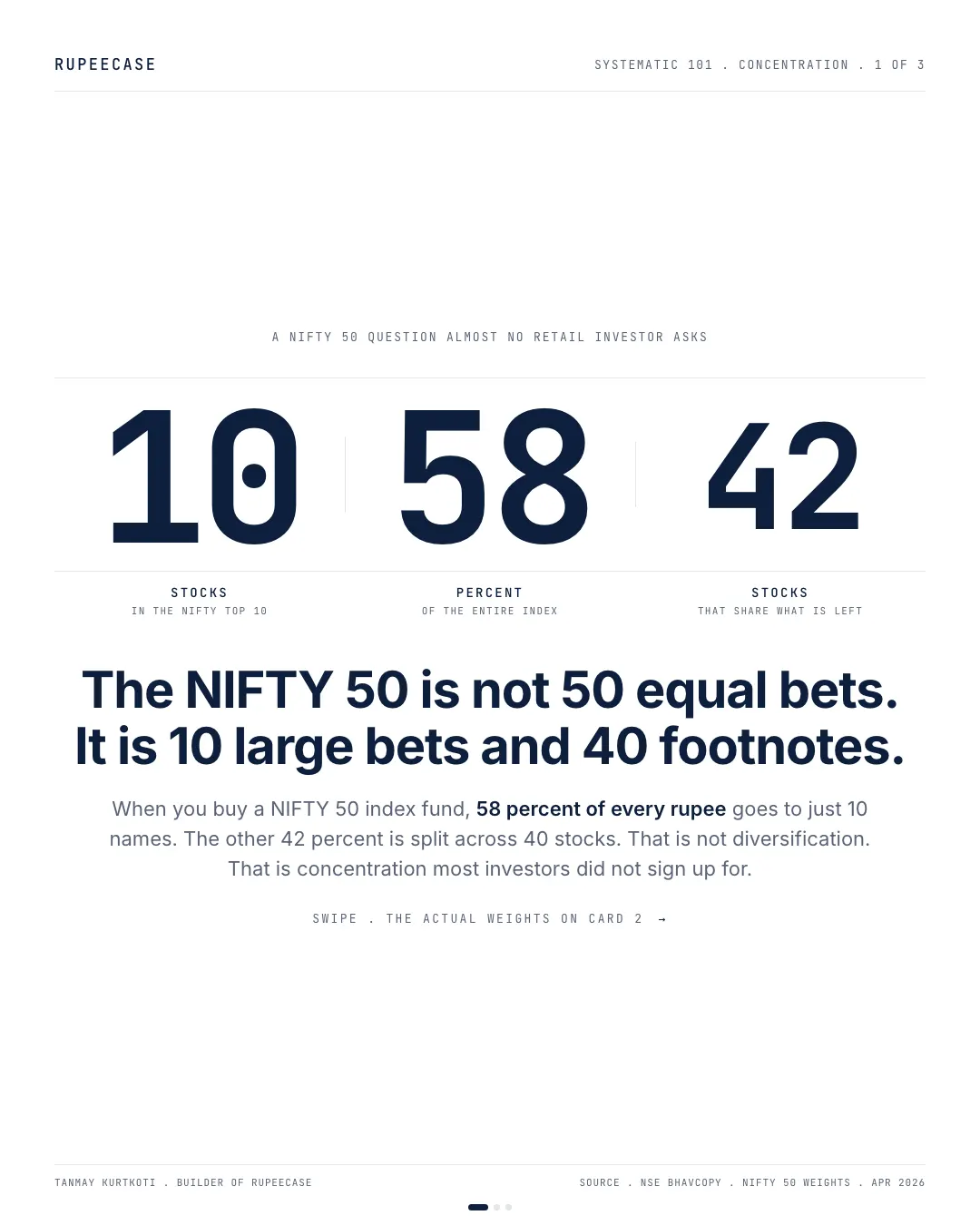
Three stocks are 30 percent of the Nifty 50 and the top ten cross 58 percent, so a cap weighted index fund is far more concentrated than the word diversified suggests.
By Tanmay Kurtkoti, founder of QC Alpha and builder of RupeeCase
Pulled the NIFTY 50 weights this morning. Wanted to test something.
The NIFTY 50 gets sold as a "diversified" basket of 50 stocks. Look at the weights and the math tells a different story.
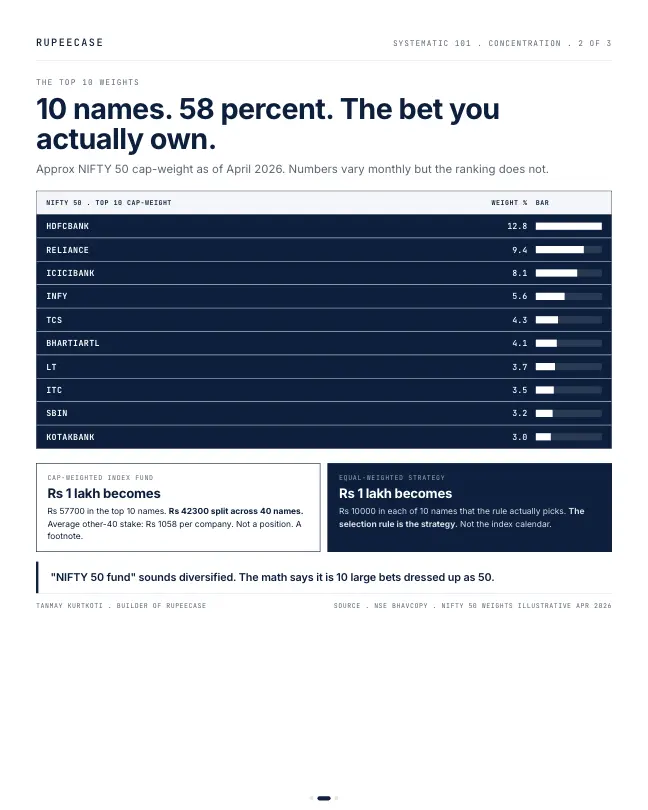
HDFCBANK alone is 12.8 percent of the index. RELIANCE 9.4. ICICIBANK 8.1. By the time you add the next 7 names you've crossed 58 percent of every rupee. The remaining 40 stocks share what's left. Average position outside the top 10 works out to about 1 percent. Per-stock factsheets sit at rupeecase.com/stocks/
That isn't a 50 stock portfolio. That's 10 stocks plus 40 footnotes. And it isn't a bug in the NIFTY 50, it's the design.
Cap-weighting compounds the existing winners. Whichever stock went up most last year quietly bought more of itself in your fund. The index re-weights monthly to reflect market cap. Which is just a polite way of saying "buy more of what already won." A walk through this math sits inside /learn/ at rupeecase.com/learn/
The fix isn't to abandon the universe. The 50 NIFTY names are still the strongest 50 large caps in the country. The fix is changing the rule that picks which names you actually own and how much of each. Methodology open at rupeecase.com/strategies/methodology
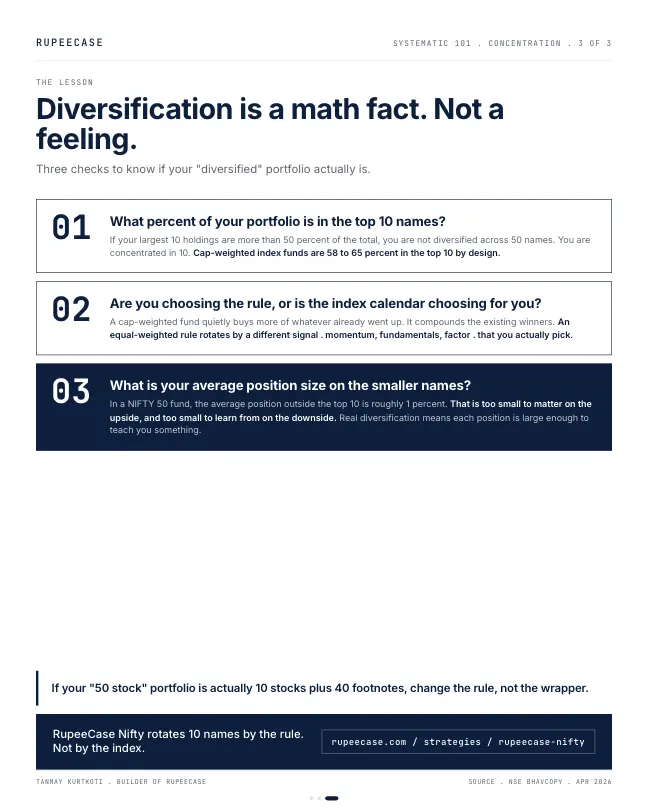
Three questions I keep asking when I look at a portfolio.
What percent is in the top 10 names? Above 50 percent and you are concentrated, not diversified. You can match yours against ours at rupeecase.com/compare
Are you choosing the rule, or is the index calendar choosing for you? Cap-weight is a passive rule that runs on autopilot. Equal-weight, momentum, factor screens are rules you actually pick.
What is the average size of your smaller positions? Below 2 percent and those names are too small to matter on the upside, too small to teach you anything on the downside. The 28 question risk profile at rupeecase.com/risk-profile surfaces this.
If your "50 stock portfolio" is actually 10 stocks plus 40 footnotes, change the rule. Not the wrapper.
RupeeCase Nifty 50 Equal Weight holds all 50 names at equal weight and rebalances by the rule, not the index calendar. rupeecase.com/strategies/nifty-50-equal-weight
How many stocks you really own: the effective count
There is a single number that turns "10 stocks plus 40 footnotes" into arithmetic. It is called the effective number of stocks. Square every weight, add the squares, and divide one by the total. A portfolio of 50 names at exactly 2 percent each scores 50. A portfolio with one stock at 100 percent scores 1. Everything real sits somewhere in between.
Take the shape from the opening as a worked example. Put 58 percent in the top 10 names, 5.8 percent each to keep the sum simple, and spread the other 42 percent across 40 names at 1.05 percent each. The squares add up to 0.0336 from the top 10 and 0.0044 from the tail, 0.0380 in all. One divided by 0.0380 is 26.3. Fifty tickers, the diversification of about 26 equal positions.
And that is the generous version. The real top 10 is not flat: 12.8, 9.4 and 8.1 at the top pull the squares up hard, so the true effective count of a cap weighted index sits well below the simplified figure.
Push the top 10 share to 70 percent and the count falls to about 20. Drop it to 20 percent and every name sits at 2 percent, so the count is the full 50. The same 50 tickers, a very different amount of diversification.
Two rules for the same 50 names
Cap weight and equal weight start from the same list. They part ways on one decision: what happens to a stock that has just run up.
Weight follows market value
- A stock that doubles roughly doubles its weight
- No trade is needed to let winners grow
- The biggest names set most of the return
Every name starts at 2 percent
- A stock that runs gets trimmed back at the rebalance
- Laggards get topped up to 2 percent
- Number 50 matters as much as number 1
Neither rule is free. Cap weight trades almost nothing and rides the leaders, which works beautifully in a market led by a few giants and hurts when those giants stall. Equal weight trades every period, carries more of the smaller large caps, and pays costs and short term tax for the privilege. The choice is about which risk you want to carry, not about which rule is clever.
What the equal weight rule did in the model
RupeeCase runs the second rule as a strategy: all 50 Nifty names at equal weight, rebalanced every four weeks. In the model it compounded at 16.35 percent a year with a maximum drawdown of 15.71 percent (Model, back tested, as of 27 Apr 2026). The line below starts at Rs 100 in Jul 2021.
Rs 100 in the Nifty 50 Equal Weight model grew to about 214 between Jul 2021 and Jul 2026; the smoothed Nifty 50 TRI reference line rose to about 160.
Read that chart with two caveats. The index line here is a smoothed 9.8 percent a year reference for the Nifty 50 TRI, not the daily index. And five years is one stretch of market history, in which mid sized large caps did well. Equal weight has had long spells behind cap weight too, usually when the very biggest companies lead. The optimizer post explains why a rule that makes no forecasts is hard to beat over longer runs.
Myths about the index you already own
MythAn index fund on the Nifty 50 spreads your money evenly across 50 companies.
FactIt spreads it by market value. In the shape above, 58 percent sits in 10 names and the effective count is closer to 26 than to 50.
MythEqual weight means more risk because it owns smaller companies.
FactEvery name is still a Nifty 50 large cap. Equal weight moves risk from a few giants to all 50, which lowers single stock concentration.
The free Learn module on indices and benchmarks walks through how NSE builds the Nifty 50, why it is free float cap weighted, and how a benchmark should be read against any strategy. The tracking error calculator shows how far a different rule on the same universe tends to drift from the index in a normal year.
Questions readers ask
Is a Nifty 50 index fund really diversified?
It holds 50 companies, but by market value, so the largest names dominate. With 58 percent in the top 10, the portfolio behaves like roughly 26 equal positions or fewer, not 50. It is diversified across large caps, and concentrated inside them.
What is the difference between equal weight and market cap weight?
Market cap weight gives each company a share in line with its market value, so winners grow their weight without any trade. Equal weight gives every company the same share and rebalances back to it, trimming what ran and topping up what lagged. The first is cheaper to run; the second spreads single stock risk more evenly.
Does equal weight always beat the Nifty 50?
No. It tends to do better when mid sized large caps lead and worse when a handful of the biggest companies drive the market. Its costs are also higher because it trades at every rebalance.
The cards
3 cards. Swipe, or tap to open.
Explore next
Learn it properly, then see it applied.
- GuideEqual weight vs market cap: what the NSE record shows for the same 100 companiesThe same 100 companies held two ways since 2013: returns, falls and costs.
- Free module 4.1Modern Portfolio Theory, What Actually Matters11 min read
- Free module 1.3Indices & Benchmarks13 min read
- CalculatorTracking errorFree, with the formula and a worked example
- StrategyNifty 50 Equal Weight strategyNifty 50, 50 stocks, every 4 weeks
- Blog topicPortfolio construction notes33 notes
Related
- The optimizer is an error maximizerOne point of forecast error moved eighty points of portfolio weight in a three stock demo, which is why DeMiguel, Garlappi and Uppal found equal weight hard to beat out of sample.Portfolio construction . . 5 min
- Risk profile fit: the drawdown you can actually sit throughMax drawdowns across the RupeeCase shelf ran from 16.92 to 39.48 percent when this was written, and SEBI's two axis rule makes your honest profile the lower of capacity and tolerance.Portfolio construction . . 5 min
- How many stocks do you actually ownSeven mutual funds held 92 unique names, but the top ten carried 47 percent of the money and the long tail was too small to matter either way.Portfolio construction . . 5 min
Educational content only. Figures are illustrative and computed on historical or representative data for teaching purposes, not investment advice. Past performance does not guarantee future returns. Sourced from NSE, BSE, SEBI, AMFI and RBI public data.