

Every July the tax portal greets you with a return that is already half filled. Your sales are there, your dividends are there, your interest is there. It is tempting to click through. Do not. The pre filled numbers come from what brokers, depositories and fund houses report, and those reports often miss the one figure that decides your tax: what you paid. One evening of reconciliation can be the best paid hour of your year.
Year the Annual Information Statement went live on the e-filing portal
CBDT, Nov 2021
July: the due date for ITR-1 and ITR-2 filers; non-audit business cases such as F&O traders get 31 August from tax year 2026-27
Finance Act 2026
Months allowed to file an updated return, from the Finance Act 2025
Updated return, ITR-U
Months: the line between 20% and 12.5% on listed equity
Since 23 Jul 2024
What are AIS and TIS?
The Annual Information Statement is the tax department's record of what third parties reported about you in a financial year. Since November 2021 it sits on the e-filing portal next to Form 26AS, which still shows tax deducted and collected at source. AIS goes much further: sales of shares and fund units, dividends, interest, large purchases and other specified financial transactions.
The Taxpayer Information Summary is the same data rolled up by category: salary, interest, dividends, sale of securities, and so on. The portal uses TIS to pre fill your return.
Where AIS data comes from
- Stock exchanges and depositories, through your broker: sales of shares and ETF units, corporate actions.
- Mutual fund registrars: redemptions, switches and IDCW.
- Banks and post offices: interest, deposits, cash transactions.
- Companies: dividends paid, with TDS.
- Others: property registrations, foreign remittances, large card spends.
What it does not know
AIS knows what you sold and for how much. It often does not know what you paid, when you really bought, whether a bonus or split changed your cost per share, or whether the 2018 grandfathering applies. Those gaps are yours to fill.
MythIf the portal pre fills my capital gains, they must be right.
FactPre filled gains come from reported sale values. Missing costs, bonus adjustments and grandfathering are common gaps, and they usually push your gain, and your tax, up.
Reading your AIS: the securities section
What each line shows
- Sale value: what you received. Almost always present.
- Cost of acquisition: what you paid. Often blank or wrong.
- Dates and holding period: sometimes present, sometimes based on settlement rather than trade date.
- Gain: sale value minus cost. If cost is blank, the "gain" is the whole sale value.
Worked example. You sell shares for ₹1,00,000 that cost ₹65,000. If the cost field is blank, a careless return reports a ₹1,00,000 gain instead of ₹35,000. At 20% short term, that is ₹20,000 of tax instead of ₹7,000.
Common AIS errors
- Missing cost. The single biggest source of overstated gains.
- Bonus and split not adjusted. After a 1:1 bonus, the cost per share halves across old and new shares; a feed that ignores this shows the bonus shares at zero cost.
- Lot order. Demat sales follow first in, first out. A feed that matches the wrong lot gets both cost and holding period wrong.
- Off market transfers. A gift to family can appear as a sale.
- Duplicates. The same sale reported twice, or by two sources.
For each wrong line, AIS has a feedback option: you can mark information as incorrect, duplicate, belonging to someone else, or give the correct value. The reporting source is then asked to confirm or correct it. Feedback does not change your return automatically, but it puts your position on record.
TIS: the aggregated view
Because TIS adds up AIS, every error above flows into the totals that pre fill your return. Treat TIS as a checklist of what the department knows, not as the answer. If your return differs from TIS because you corrected a cost, that is fine; keep the evidence.
Reconciliation: step by step
- Download everythingAIS as PDF and JSON, Form 26AS, your broker's capital gains statement, and fund statements for the full year.
- Match every saleDate, security, quantity and sale value, line by line between AIS and the broker statement. Trade date and settlement date can differ by a day.
- Fix the costsTake the cost from your broker's statement or contract notes for every line where AIS is blank or wrong.
- Check holding periodsFrom purchase date to sale date, using FIFO. Under 12 months is 20%; 12 months or more is 12.5% above ₹1.25 lakh.
- Apply corporate actions and grandfatheringAdjust cost for bonuses and splits; for shares bought by 31 January 2018, use the grandfathered cost.
- Find what is missingSales in the broker statement but not in AIS still have to be reported.
- Give AIS feedback, then fileReport your reconciled figures, not the pre filled ones, and keep the workings.
Mutual fund redemptions
With SIPs, every instalment is a separate lot with its own cost and date. Redemptions use the oldest units first. Your fund's capital gains statement does this matching for you; compare its totals with AIS scheme by scheme.
Grandfathering
For listed shares and equity fund units bought on or before 31 January 2018, the cost for long term gains is the higher of your actual cost and the lower of the 31 January 2018 value and your sale price. AIS does not apply this. The return asks for these holdings scrip by scrip in Schedule 112A, with the 2018 value.
Illustration: where reported gain of ₹14.7 lakh differs from the true ₹11.2 lakh
- Missing purchase costs₹1,80,000
- Bonus not adjusted₹95,000
- Grandfathering not applied₹60,000
- Wrong holding periods₹15,000
Illustration, not a real taxpayer. If all of it were long term gain, filing the pre filled figure would overpay ₹43,750 before cess.
Filing the return
Which form
- ITR-2: capital gains with no business income.
- ITR-3: if you also have business income, including F&O or intraday trading. From tax year 2026-27 the due date for non-audit business cases is 31 August, against 31 July for ITR-2.
Schedule CG and Schedule 112A
Short term gains on listed equity go in the section 111A rows at 20%; long term equity gains in the section 112A rows at 12.5% above ₹1.25 lakh. For income earned up to 31 March 2026 these are still the 1961 Act sections. From tax year 2026-27 the same rates sit in sections 196 and 198 of the Income-tax Act, 2025, and the forms will follow the new numbering.
One quirk applies only to the year 2024-25: because the rates changed on 23 July 2024, that year's return asked for gains split into before and after that date. For 2025-26 and later the whole year is at the new rates.
Losses
Capital losses carry forward for 8 years only if the return for the loss year is filed by the due date. A late return keeps the tax computation but loses that right. If you discover an error after filing, you can revise the return before the year's deadline, and the updated return route now stays open for up to 48 months, with extra tax payable.
Tools for reconciliation
Your broker's capital gains or tax profit and loss report is the most reliable starting point: it comes from the same source that reported to the department and carries costs, dates and lots. Fund registrars provide a consolidated capital gains statement across fund houses. A spreadsheet with one row per sale, AIS on the left and the broker on the right, and a difference column, is all the software most people need.
If you use a tax professional, give them the broker report, not just the AIS. Ask how they treated bonus shares and grandfathered holdings. A good one will ask you first.
Common mistakes
- Accepting a blank cost. It turns the whole sale value into gain.
- Ignoring bonus and split adjustments.
- Filing after the due date and losing loss carry forward.
- Leaving out a sale AIS missed. It still has to be reported.
- Mixing F&O into Schedule CG. It is business income and needs ITR-3.
How this shows up in RupeeCase
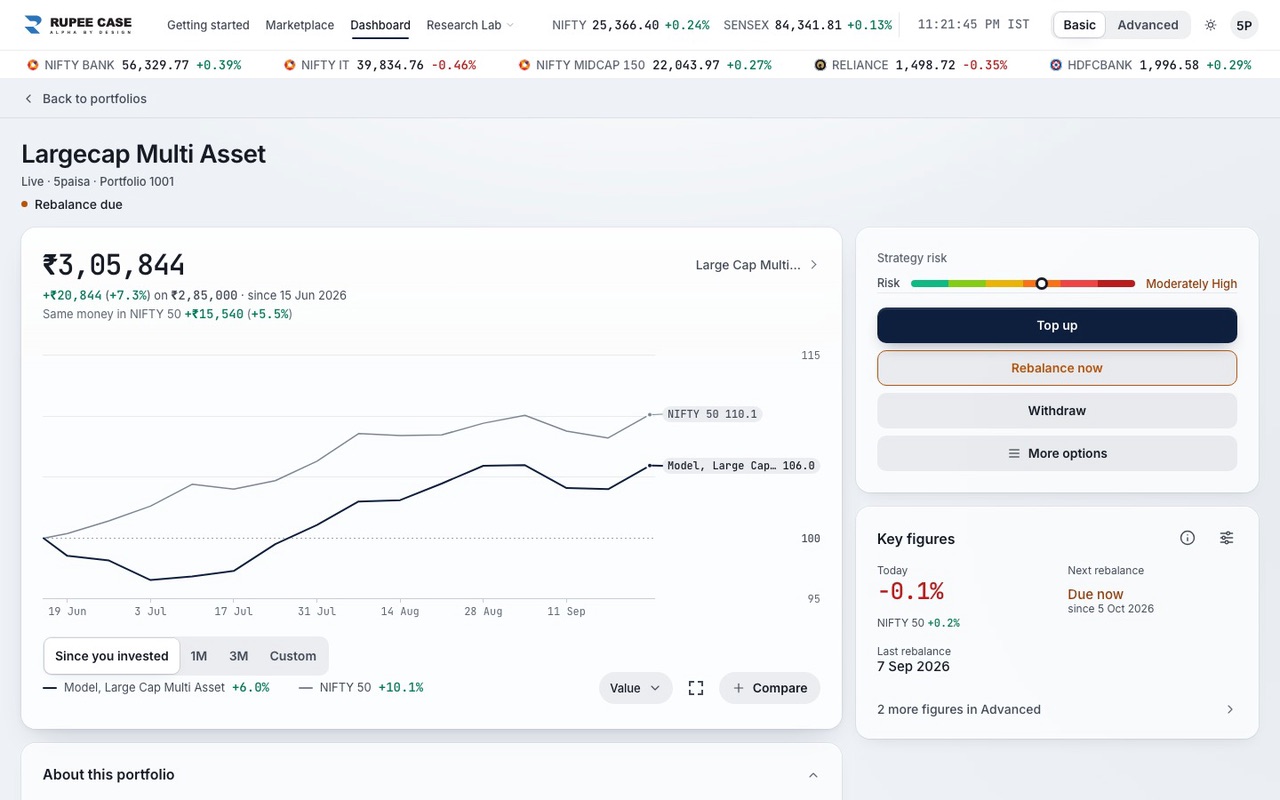
When you invest through a RupeeCase index, every trade happens in your own demat through your own broker, so your broker's capital gains report is the record for tax. The terminal keeps a ledger of money in, money out and charges for each portfolio, which helps you tie the broker numbers back to each rebalance. For an index that rebalances every two weeks, like Smallcap, expect many short term lines at year end and plan the reconciliation evening accordingly.
Questions people ask me
Is AIS the same as Form 26AS?
No. Form 26AS still shows tax deducted and collected at source and some other items. AIS, introduced in November 2021, is much wider and lists sales of securities, dividends, interest and other reported transactions.
What if my AIS shows a sale with zero cost?
Report the correct cost from your broker's statement or contract note in your return, and submit feedback on that AIS line. Keep the documents in case you are asked.
I found an error after filing. What can I do?
Revise the return before the year's revision deadline. After that, an updated return can be filed within 48 months under the Finance Act 2025, with additional tax.
What to remember
- AIS lists what was reported; it often lacks your cost.
- Reconcile every sale against your broker's capital gains report.
- Adjust for bonuses, splits and 2018 grandfathering yourself.
- File by the due date to keep losses alive for 8 years.
- F&O and intraday go in ITR-3, not in capital gains.
Rules and figures in this module were last verified on 12 Oct 2026. Tax and regulatory rules change; check the source before acting.